Nothing
Phone (4a)
Ranked #37 of 42 devices tested
Score Overview
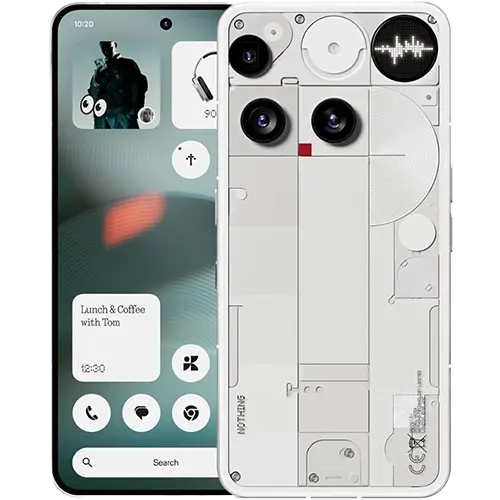
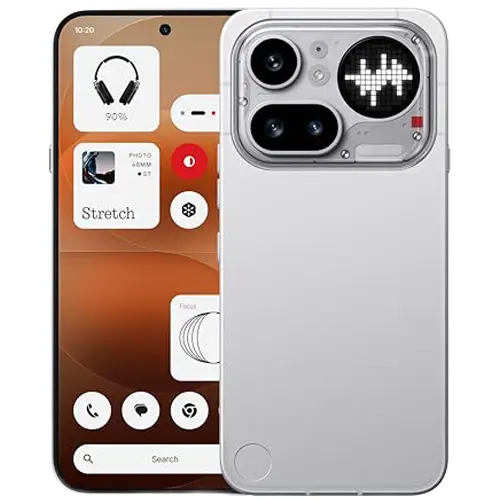
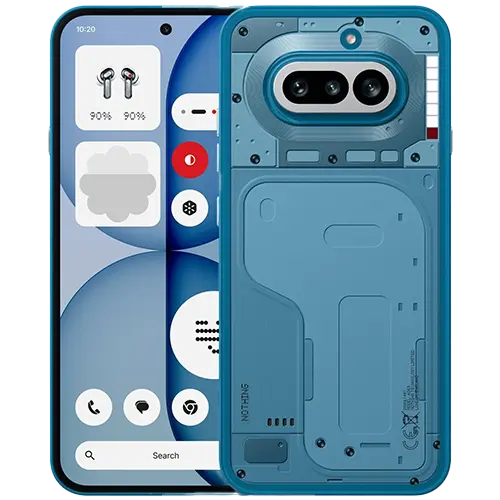
The Nothing Phone (4a) is a budget-priced phone aimed at buyers who want a capable triple-camera system and a large display without spending flagship money. At £349, it competes with mid-range devices from Google, Samsung, and Motorola, and it's one of the few phones at this price to include a dedicated telephoto lens.
The phone's camera system is its clearest strength, delivering solid results across all four lenses. The microphone and biometrics also perform above average for the price. Battery life, charging speed, raw processing power, and speaker quality all fall short of what similarly priced alternatives offer, though.
Here’s how the Nothing Phone (4a) performed in our testing.
Design
Specifications
The Nothing Phone (4a) measures 164 x 77.6 x 8.6mm and weighs 204.5g. It's a large phone. The frame is plastic, the back is glass, and the front is protected by Gorilla Glass 7i. It carries an IP64 rating, meaning it's protected against dust ingress and water splashes but is not rated for submersion. The Google Pixel 10a is smaller and lighter at 153.9 x 73mm and 183g, with an IP68 rating that covers full submersion and an aluminum frame.
The display has a 20:9 aspect ratio with an 87.2% screen-to-body ratio, giving visible bezels that are not unusually thick for the price. We don’t formally test durability.
Display
The Phone (4a) has a 6.78-inch AMOLED display running at 1224 x 2720 resolution, giving it a pixel density of 440 pixels per inch. It supports a 120Hz refresh rate that can drop to 30Hz to save power — but it’s not an LTPO panel that can drop all the way down to 1Hz.
Manual brightness tops out at about 781 nits, which is adequate for indoor use but noticeably lower than the Pixel 10a's 1,403 nits. In direct sunlight, the difference would be visible. Peak HDR brightness reaches roughly 1,522 nits. The panel holds this peak luminance without thermal throttling during sustained HDR playback. Sustained brightness stability is 99.1%. Minimum brightness is about 1.9 nits, which is comfortable for dark rooms.
Color accuracy is reasonable. In Standard Mode, which targets the sRGB color space used for most web content and apps, the display achieves an average Delta E of 1.74. Delta E measures how far displayed colors deviate from their target values; anything under 2 is generally accurate enough that most people won't notice errors. Standard Mode covers 96.2% of sRGB. Alive Mode targets the wider Display P3 gamut, covering 93.5% of it, with an average Delta E of 2.14. Both modes show good accuracy, though neither is exceptional compared to pricier OLED panels.
Touch latency averages 9.6 milliseconds. This is faster than the Pixel 10a's 15ms average. In practice, both are responsive enough that the difference is unlikely to be perceptible.
Display Gamut Coverage
Sustained Brightness
HDR Brightness
HDR Tone Mapping
Performance
The Phone (4a) runs on the Qualcomm Snapdragon 7s Gen 4 with 8GB or 12GB of RAM. This is a budget-oriented chipset, and benchmark results reflect that.
Geekbench 6 scores come in at 1,250 single-core and 3,374 multi-core. The Pixel 10a's Tensor G4 posts 1,716 and 4,385 respectively, a meaningful gap visible in app launch times and multitasking. In the 3DMark Wild Life Extreme GPU stress test, the Phone (4a) peaks at 1,118 with 98.9% stability. Performance barely drops during sustained loads. The Pixel 10a reaches 2,685 with 82.6% stability. The Phone (4a) delivers less graphical power but throttles far less. For casual gaming this is fine, but for demanding 3D titles, frame rates will be limited.
Browser performance via Speedometer returns 11.3, compared to the Pixel 10a's 17.7. AI benchmark scores are modest, with a quantized score of 11,898 on the QNN backend. AI-powered features like on-device photo processing and language tasks will work but won't be as responsive as on phones with more capable neural processing units.
Performance Benchmarks
Bars positioned relative to the best score in our database.
Wild Life Extreme Stress Test
Camera
The Phone (4a) has a four-lens camera setup, made up of a 50-megapixel main sensor, an 8-megapixel ultrawide, a 50-megapixel telephoto, and a 32-megapixel front camera. Having a dedicated telephoto at this price is unusual and gives the phone genuine versatility over competitors like the Pixel 10a, which lacks a telephoto lens.
Overall camera performance is solid across all four lenses. Sharpness in good light is strong from the main, ultrawide, and telephoto sensors. Where the system shows its budget roots is at deep zoom levels. Beyond 20x, detail drops off rapidly. At 30x, sharpness is roughly halved compared to 10x, and by 50x and above, images are soft with limited usable detail. This is typical for a mid-range telephoto pushing past its optical range. Buyers expecting sharp results at 40x or 70x should temper expectations.
Video stabilization is a genuine highlight. The main lens produces very smooth footage, and the ultrawide is similarly well-controlled. The telephoto and front camera are slightly less stable but still perform well.
Camera Sharpness
Main
The 50-megapixel main camera produces sharp images in bright light, resolving strong detail in Auto mode. In mid and low light, sharpness drops but remains usable. Colors in Auto mode are pushed slightly warm, most noticeable in reds and skin tones. Skin tones in bright light skew noticeably warm. In mid-light conditions, the processing shifts colors toward warm tones from both reddish and yellowish biases. This is partly incomplete white balance correction for warmer light and partly a deliberate processing choice. In low light, reddish bias becomes more prominent while the yellow shift largely disappears, suggesting the sensor itself introduces some hue confusion at higher sensitivity rather than a white balance issue.
Dynamic range in Auto mode is good, preserving detail across a wide range of brightness levels, though highlights clip in the brightest areas. The phone uses aggressive HDR processing to compress the tonal range, keeping shadow detail visible but sometimes making high-contrast scenes look slightly flat.
Color Profile
Dynamic Range
Ultrawide
The 8-megapixel ultrawide resolves surprisingly good detail in bright and mid light for an ultrawide at this price. Color accuracy in Auto mode is the weakest of the four lenses though, with saturation pushed noticeably, particularly in mid-light conditions where it reaches close to 119% of reference. Greens and reds are pushed hardest. In low light, noise climbs substantially in raw captures, but Auto mode processing cleans it up at the cost of fine detail.
Dynamic range from the ultrawide is strong, with good shadow recovery and solid highlight handling. The lens slightly clips highlights in very bright areas but preserves tonal gradation well across the rest of the range.
Color Profile
Dynamic Range
Telephoto
The 50-megapixel telephoto at 4x optical zoom delivers clean, sharp results in bright light and holds up well in mid conditions. In low light, sharpness drops more significantly than the main lens, expected given the smaller sensor and narrower f/2.9 aperture. Color accuracy from the telephoto is the best of any lens on this phone, with well-controlled saturation and consistent hues. In bright light, there's a warm yellowish shift that persists across lighting conditions, primarily a white balance tendency rather than a sensor issue. Skin tones track closely to reference values in mid and low light.
Dynamic range is good, with effective HDR processing that preserves both shadow and highlight detail. Stabilization at 4x is adequate, though it shows more residual shake than the main and ultrawide lenses.
Color Profile
Dynamic Range
Front
The 32-megapixel front camera produces sharp images in bright light that soften somewhat in mid and low conditions. Colors are fairly neutral in bright light, with saturation close to 100%. In mid light, saturation drops slightly and the image takes on a subtle cool cast. In low light, saturation undershoots more noticeably, producing somewhat muted skin tones.
Dynamic range from the front camera is good, with effective processing that pulls detail from shadows without badly clipping highlights. Stabilization during video is decent for selfie use, though it trails the rear cameras.
Color Profile
Dynamic Range
Battery
The Phone (4a) carries a 5,080 mAh battery. In video playback at 200 nits, it lasted 23 hours and 39 minutes. At maximum brightness, that drops to 20 hours and 18 minutes. The Pixel 10a managed about 26 hours at 200 nits. For most users, 23.5 hours of video playback means comfortably getting through a full day of mixed use with some charge remaining.
Web browsing drain over 5 hours was 24%, meaning the battery would last roughly 21 hours of continuous browsing. The Pixel 10a lost 19% in the same test, a meaningful difference. Gaming drain during the 3DMark stress test was 16%, low but largely reflecting the modest GPU output rather than exceptional efficiency. Standby drain overnight was 2% over 8 hours, which is good.
Overall, battery life is below average. The phone will get most people through a day, but heavy users or anyone accustomed to two-day battery life from larger-battery competitors will find it falls short.
Battery Life
Charging
The Phone (4a) charges via 50W wired USB-C. There is no wireless charging. After 10 minutes on the charger, the phone reaches 27%. After 30 minutes, it hits 66%. These are reasonable figures for 50W charging — in practice a half-hour top-up during lunch would get most users through the rest of a day.
The Pixel 10a charges at only 30W and reaches 59% in 30 minutes, so the Phone (4a) has a moderate edge in wired speed. Compared to phones with 65W or higher charging, the Phone (4a) is slower, and it lacks the wireless charging the Pixel 10a offers.
Wired Charging Curve
Speaker
The stereo speakers reach a maximum of 77.5 dB. Average total harmonic distortion is 9.85%, meaning at high volumes there is noticeable distortion. The speakers are weak in bass response, producing thin, lightweight sound that lacks depth or warmth. High-end clarity is slightly better, giving voices and treble reasonable definition, but the overall character is tinny. The Pixel 10a has cleaner output with lower distortion and slightly more bass presence, though neither phone's speakers are particularly impressive. For anything more than casual video watching or speakerphone calls, headphones are a better option.
Speaker Frequency Response
Microphone
The microphone performs well, with a frequency response standard deviation of 3.95 dB. Lower deviation means more even capture across the frequency range, and this is a strong result. Voice calls and video recordings should sound clear and natural, with good consistency across low and high pitches. This is well above average for phones at any price.
Microphone Frequency Response
Other
Measurements
Specifications
The Phone (4a) uses an optical fingerprint sensor that unlocks in an average of 187.5 milliseconds. That's fast and responsive. There is no hardware-based face unlock.
Data transfer uses USB-C 2.0, with maximum read speeds of about 41 MB/s and write speeds of about 36 MB/s. These are slow. Transferring large files or backups to a computer will take noticeably longer than on phones with USB 3.0 or higher. The Pixel 10a reads at 178 MB/s over USB-C 3.2.
Storage is available in 128GB and 256GB configurations.
Conclusion
The Nothing Phone (4a) makes its strongest case through its camera system. A dedicated telephoto at this price is genuinely rare, and all four lenses produce respectable results with good stabilization. The microphone and fingerprint sensor are also above average. Where the phone struggles is in areas that often matter most in daily use. Battery life is below average, charging is merely adequate, processing power is limited, and the speaker and display are both unremarkable for the price. The USB-C 2.0 port is a notable limitation for file transfers. The Pixel 10a, while lacking a telephoto, offers a brighter display, better battery life, faster processing, and faster data transfer with wireless charging. The Phone (4a) is best suited for someone who prioritizes camera versatility on a tight budget and can accept trade-offs elsewhere.