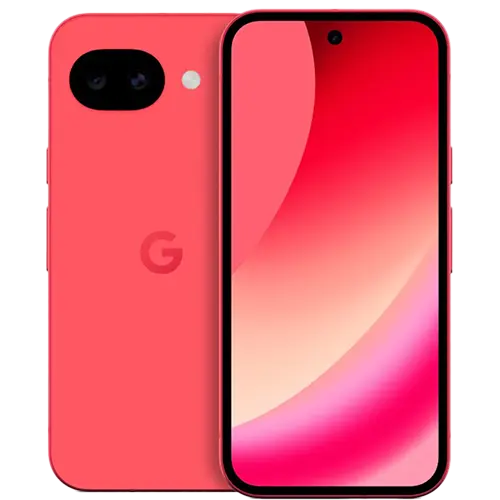
Pixel 10a
Ranked #36 of 42 devices tested
Score Overview
The Google Pixel 10a is Google's budget-friendly entry point into the Pixel lineup, carrying over the same Tensor G4 chip and camera hardware from the Pixel 9a while refining the physical package slightly. It targets buyers who want Google's software experience and computational photography without spending $800 or more on a Pixel 10. At $499, it competes with options from Nothing, and sits $100 below the iPhone 17e.
The Pixel 10a's strengths are its display brightness, camera sharpness (particularly on the ultrawide and front cameras), and solid battery life for video playback. Its main camera color accuracy in processed mode is better than both the Pixel 9a and the Pixel 10. The weaknesses are that it’s performance is limited by the older Tensor G4 chip, the speaker is below average in both bass and clarity, the microphone is weak, biometric unlock is slow, and charging speeds are modest. The plastic back and relatively thick bezels mark this as the budget tier.
Design
Specifications
The Pixel 10a measures 153.9 x 73 x 9mm and weighs 183 grams. It uses an aluminum frame, a Gorilla Glass 7i front, and a plastic back. The IP68 rating means it can handle submersion in fresh water, though the exact depth and duration depend on the manufacturer's specification.
Compared to the Pixel 9a, the 10a is almost identical. The 3-gram weight reduction is imperceptible in hand. The screen-to-body ratio is 84.7%. The 20.2:9 aspect ratio produces a tall, narrow form factor. The front glass upgrade from Gorilla Glass 3 to Gorilla Glass 7i is a meaningful spec improvement for scratch resistance. The iPhone 17e, at $599, is lighter (169 grams), thinner (7.8mm), and uses a glass back instead of plastic, though it lacks an ultrawide camera.
Bandicoot Lab does not formally test design or durability.
Display
The Pixel 10a uses a 6.3-inch P-OLED panel at 1080 x 2424 resolution (422 pixels per inch), with a 120Hz maximum refresh rate that can drop to 60Hz. Manual brightness reaches 1,403 nits, which is strong for a $499 phone and slightly higher than the Pixel 9a's 1,201 nits. It dims to 1.79 nits, making it comfortable for nighttime use. HDR peak brightness reaches 3,182 nits, which is excellent and slightly above the Pixel 10's 3,089 nits. Brightness stability over a 30 minute test is strong at nearly 98%.
Color accuracy in Natural mode is good, with an average Delta E of 1.5 against sRGB targets. This means colors are close to their reference values, though the maximum error of 4.38 indicates some individual colors drift enough to be noticeable in side-by-side comparisons. The Pixel 9a edges it out with an average Delta E of 0.91, which is very accurate. In Natural mode the display covers about 99% of sRGB and 74% of Display P3.
Touch latency averages 15ms, which is fast. The Pixel 9a measured 21.9ms and the Pixel 10 came in at 22.6ms.
Display Gamut Coverage
Sustained Brightness
HDR Brightness
HDR Tone Mapping
Performance
The Pixel 10a runs the Google Tensor G4 chip with 8GB of RAM, the same silicon found in the Pixel 9a. Geekbench 6 scores reflect this: 1,716 single-core and 4,385 multi-core, nearly identical to the Pixel 9a's 1,717 and 4,482. The Pixel 10 with its Tensor G5 pulls ahead at 2,271 single-core and 6,137 multi-core. The iPhone 17e's A19 chip operates on a different level entirely, scoring 3,669 single-core and 9,152 multi-core.
GPU performance in the 3DMark Wild Life Extreme stress test peaked at 2,685 with a worst-loop score of 2,218, giving 82.6% stability. The Pixel 10a throttles less during sustained graphics loads than both the Pixel 9a (80%) and the Pixel 10 (68.6%). In practice, the GPU is adequate for casual gaming but will struggle with graphically demanding titles at high settings.
Browser performance scored 17.7 in Speedometer, slightly below the Pixel 9a's 18.6 and well behind the iPhone 17e's 35.8.
Performance Benchmarks
Bars positioned relative to the best score in our database.
Wild Life Extreme Stress Test
Camera
The Pixel 10a carries a 48-megapixel main camera (f/1.7, 1/2.0" sensor, 25mm equivalent), a 13-megapixel ultrawide (f/2.2, 1/3.1" sensor, 14mm), and a 13-megapixel front camera (f/2.2, 1/3.1" sensor, 20mm). There is no telephoto lens — digital zoom tops out at 8x. The camera hardware is identical to the Pixel 9a.
Sharpness is a clear strength across all three lenses. The ultrawide scores particularly well, and the front camera delivers strong detail in bright and mid-light conditions. At the main lens's native 1x, sharpness is solid in bright and mid-light, though it drops in low light. The Pixel 10a distinguishes itself from the Pixel 9a at higher zoom levels. At 3x the 10a resolves noticeably more detail than the 9a, and this advantage persists through 5x, 6x, and 8x. This improvement in digital zoom quality given identical sensor hardware suggests updated processing algorithms. The iPhone 17e retains more detail at equivalent zoom levels.
Camera Sharpness
Main
In bright light, the main camera produces good detail at 1x with moderate color saturation boost. Colors are pushed about 31% above reference values, with reds and warm tones shifted most. Skin tones specifically deviate from reference, running warmer than reality. In mid-light conditions (simulating indoor tungsten lighting at 100 lux), saturation increases further to about 143%, but overall color error actually improves. The white balance shows a consistent cool shift, pulling blues slightly forward across all lighting conditions. This blue-leaning tendency is present even in bright light and intensifies in mid-light, suggesting it's partly a processing choice.
In low light, the main camera holds color accuracy better than many competitors. The Pixel 9a showed a strong warm bias in dark conditions, while the Pixel 10a's dark-condition color handling is more neutral with a mild warm shift. Hue accuracy remains relatively consistent across lighting conditions.
Dynamic range in auto mode is good. The processing retains shadow detail while managing highlights, though some highlight clipping occurs in high-contrast scenes. Compared to the Pixel 9a, which showed wider dynamic range capture, the 10a's processing appears to use less aggressive tone compression, resulting in a slightly more natural look but with slightly less recovered shadow detail. The iPhone 17e handles dynamic range similarly to the Pixel 10a in auto mode.
Color Profile
Dynamic Range
Ultrawide
The ultrawide lens produces strong sharpness scores in all lighting conditions, outperforming the main lens in the 10a's own lineup and significantly outperforming the Pixel 9a's ultrawide. Color accuracy in auto mode is weaker than the main camera, with higher overall error and more aggressive skin tone shifts, especially in mid and bright light. The saturation boost is comparable to the main lens at around 130%, but hue errors are larger, particularly for skin tones.
In raw mode, the ultrawide's color accuracy is quite good, with low color error in bright light and reasonable accuracy in dark conditions. This gap between raw and processed output suggests the ultrawide's processing pipeline is more aggressive than the main camera's.
Dynamic range is narrower than the main camera in auto mode, and the processing introduces more tone-mapping artifacts. Highlights clip earlier. For landscape and architectural shots in good light, the ultrawide performs well. In mixed or low light, results are less reliable.
Color Profile
Dynamic Range
Front
The 13-megapixel front camera delivers strong sharpness, especially in bright and mid-light. It outperforms the Pixel 9a's front camera and even the iPhone 17e's selfie camera in raw detail.
Color accuracy in auto mode follows the same pattern as the rear cameras — saturation is pushed up (around 120–132% depending on lighting), and skin tones run warm. In mid-light, skin tone error is particularly high. Raw output shows notably good color accuracy at mid and dark conditions.
Dynamic range is solid for a front camera. Video stabilization on the front camera is average.
Color Profile
Dynamic Range
Battery
The Pixel 10a packs a 5,100 mAh battery, the same capacity as the Pixel 9a. Video playback at 200 nits ran for 25 hours and 57 minutes, which is close to the Pixel 9a's 26 hours and 38 minutes.
Web browsing over five hours drained 19% of the battery, identical to the Pixel 9a and meaningfully better than the iPhone 17e's 33% over the same period. This translates to roughly a full day of moderate web use from a full charge. Gaming drain was 23% during the stress test, slightly higher than the Pixel 9a's 22%, which is a negligible difference. Standby drain was 3% over eight hours, matching the iPhone 17e but slightly higher than the Pixel 9a's 2%.
Overall, the Pixel 10a delivers about the same battery life as its predecessor, which was already good for its price class. The roughly 26 hours of video playback at a comfortable brightness means most users will comfortably get through a full day, and lighter users may stretch to two.
Battery Life
Charging
Wired charging is rated at 30W, up from the Pixel 9a's 23W. After 10 minutes, the Pixel 10a reaches 21%, and after 30 minutes it hits 59%. This is a clear improvement over the Pixel 9a, which managed 17% at 10 minutes and 47% at 30 minutes. The iPhone 17e, despite its 20W rating, reaches 25% at 10 minutes and 61% at 30 minutes thanks to its smaller 4,005 mAh battery.
Wireless charging is rated at 10W, up from 7.5W on the Pixel 9a. After 30 minutes on a wireless charger, the Pixel 10a reaches 14%, compared to the 9a's 12%. This is still slow. The Pixel 10a does not support magnetic wireless charging, even though the Pixel 10 at $799 does.
Charging speed overall is below average for this price range. 30 minutes on a wire gets you past half, which is functional but not fast.
Wired Charging Curve
Wireless Charging Curve
Speaker
The Pixel 10a's speaker reaches a maximum of 75.4 dB, which is reasonably loud and close to the Pixel 10's 76 dB. The Pixel 9a measured 71.6 dB, so the volume increase is audible and welcome. Average total harmonic distortion is 7.72%, which is mediocre. The iPhone 17e is cleaner at 4.45% and the Pixel 10 at 6.28%.
The frequency character leans thin. Bass response is limited, which is typical for a phone speaker but falls below what some competitors deliver at this price. High-frequency clarity is also below average, so vocals and instruments in the upper registers lack presence. The speaker is functional for casual listening and video calls but is not a strength of this phone. The Pixel 9a had similar limitations, and the 10a hasn't addressed them beyond adding some volume.
Speaker Frequency Response
Microphone
The Pixel 10a's microphone has a standard deviation of 8.68 across its frequency response, which is high. This means the microphone emphasizes some frequencies and suppresses others more than average, resulting in uneven sound that can make voices sound less natural in recordings or calls. The Pixel 9a (4.34) and Pixel 10 (4.30) both have much flatter microphone responses. This is a notable weakness.
Microphone Frequency Response
Other
Measurements
Specifications
The Pixel 10a uses an optical under-display fingerprint sensor that averages 265.3 milliseconds to unlock.
Data transfer via USB-C 3.2 is fast. The Pixel 10a reads at about 178 MB/s and writes at about 197 MB/s for large files. These are strong numbers, nearly identical to the Pixel 9a and far ahead of the iPhone 17e's USB 2.0 speeds (about 39 MB/s read and write).
Storage is available in 128GB and 256GB configurations.
Conclusion
The Pixel 10a is a modest refinement of the Pixel 9a rather than a generational leap. It keeps the same chip and camera sensors but improves digital zoom processing, increases charging speed, upgrades the front glass, and adds a brighter display with faster touch response. Battery life remains strong, and the camera system produces good images with better sharpness at zoom than its predecessor.
The trade-offs are the same as before. Performance is limited by the aging Tensor G4, the speaker and microphone are both below average, and charging is slow by modern standards. The fingerprint sensor is slower than it should be. At $499, the Pixel 10a offers a capable camera and clean software experience, but buyers who prioritize raw performance, audio quality, or fast charging will find better options elsewhere. The iPhone 17e at $599 delivers stronger performance and better speakers but lacks an ultrawide camera and has shorter battery life. The Pixel 10 at $799 adds a telephoto lens, faster chip, ultrasonic fingerprint sensor, and better speakers. The Pixel 10a fills its role as an affordable Pixel competently, with photography and battery life as its strongest arguments.
Related
Best Phones for Gaming
Pixel 10 Pro Fold
Pixel 10
Pixel 10 Pro
Pixel 10 Pro XL
RedMagic
11 Air
Apple
iPhone 17e
Apple
iPhone 16e
Nothing
Phone (4a) Pro
Nothing