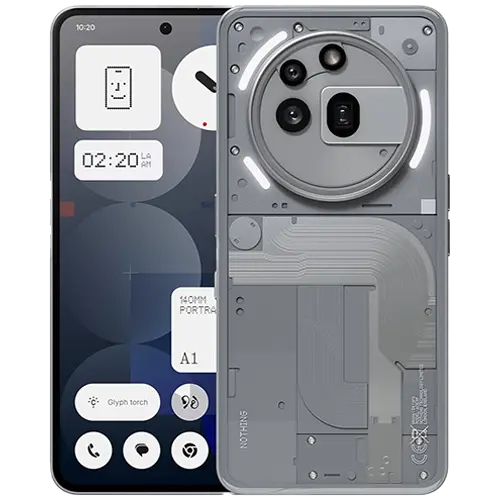
Nothing
Phone (3a) Pro
Ranked #38 of 42 devices tested
Score Overview
The Nothing Phone (3a) Pro is a mid-range Android phone positioned as a camera-focused alternative in the $400–500 space. It pairs a triple rear camera system, including a dedicated 3x telephoto, with Nothing's distinctive transparent design language. The target buyer is someone who wants optical zoom versatility and a large display without paying flagship prices.
The camera system is the phone's clearest strength, delivering color accuracy and telephoto performance that compete well above its price. Battery life is adequate but unexceptional, and charging is middle of the pack. The display, speakers, and raw processing power all fall short of what similarly priced phones offer, and the microphone quality is weak. Buyers prioritizing camera versatility over all-around polish will find the most to like here.
Design
Specifications
The Phone (3a) Pro measures 163.5 x 77.5 x 8.4mm and weighs 211g. It uses a plastic frame with Panda Glass on the front. It has an IP64 rating, meaning it's protected against splashing water but not submersion. The Google Pixel 10a at $499 has full IP68 submersion resistance, and the iPhone 17e at $599 offers the same. Buyers who want peace of mind near water should note the gap.
At 211g, the Phone (3a) Pro is noticeably heavier than the Pixel 10a (183g) and iPhone 17e (169g), though both of those have smaller displays. The Nothing CMF Phone 2 Pro, a sibling device with a nearly identical body size (164 x 78 x 7.8mm), is lighter at 185g.
The 6.77-inch display with a 19.9:9 aspect ratio and 87.6% screen-to-body ratio makes for a tall, wide phone with moderate bezels. The single USB-C 2.0 port handles charging and data. No wireless charging is available.
Bandicoot Lab does not formally test design or durability.
Display
The Phone (3a) Pro uses a 6.77-inch AMOLED panel at 1080 x 2392 resolution (387 pixels per inch), with a 120Hz maximum refresh rate that drops to 30Hz for static content. The display offers two color modes, including Alive Mode, which targets the Display P3 color space (covering 95.15% of it), and Standard Mode, which targets sRGB (covering 97.31%).
Brightness is a weak point. Manual brightness tops out at about 777 nits, and HDR peak brightness reaches 1,371 nits. The Pixel 10a hits 1,403 nits manually and 3,182 nits at peak HDR. In practice, the Phone (3a) Pro will be harder to read in direct sunlight than many competitors. Sustained brightness over a 30-minute HDR load holds at 98.49%, meaning the panel doesn't throttle significantly under prolonged bright content.
The minimum brightness dips to 2.55 nits, which is adequate for dark-room use, though higher than some of the competition that can hit under 1 nit.
Color accuracy is average. The best mode, Standard, produces an average Delta E of 2.29, meaning colors generally look close to their reference values but with occasional visible drift, particularly on certain hues where the max Delta E reaches 5.71. Alive Mode is slightly less accurate at an average Delta E of 2.52. The Pixel 10a's Natural Mode achieves 1.5 average Delta E, and the iPhone 17e's Standard Mode reaches 0.94, both noticeably tighter.
Touch latency averages 18.4 milliseconds. This is fast enough that most users won't perceive any delay between finger and screen response. The Pixel 10a is slightly quicker at 15ms.
Display Gamut Coverage
Sustained Brightness
HDR Brightness
HDR Tone Mapping
Performance
The Phone (3a) Pro runs the Qualcomm Snapdragon 7s Gen 3 with either 8GB or 12GB of RAM. Storage options are 128GB and 256GB.
CPU performance is modest. Geekbench 6 returns a single-core score of 1,167 and a multi-core score of 3,277. The Pixel 10a's Tensor G4 scores 1,716 single-core and 4,385 multi-core, a substantial lead. The iPhone 17e's A19 chip scores 3,669 single-core and 9,152 multi-core. In daily tasks like app launching and multitasking, the Phone (3a) Pro will feel adequate but noticeably slower than either competitor under sustained load.
GPU performance is limited. The 3DMark Wild Life Extreme stress test peaks at 1,065 with a worst-loop score of 1,062, yielding 99.7% stability — because it doesn’t really perform well enough to need to be throttled. The Pixel 10a peaks at 2,685 and the iPhone 17e at 3,884, meaning graphically demanding games will run at lower settings or frame rates on the Phone (3a) Pro.
Browser performance via Speedometer scores 10.9, behind the Pixel 10a's 17.7 and far behind the iPhone 17e's 35.8. Complex web apps and heavy pages will feel sluggish.
Performance Benchmarks
Bars positioned relative to the best score in our database.
Wild Life Extreme Stress Test
Camera
The Phone (3a) Pro carries a 50-megapixel main camera (f/1.9, 1/1.56" sensor), an 8-megapixel ultrawide (f/2.2, 0.6x), a 50-megapixel 3x telephoto (f/2.6, 1/1.95" sensor), and a 50-megapixel front camera (f/2.2). The inclusion of a dedicated telephoto with a large sensor is unusual at this price. The Pixel 10a and iPhone 17e both lack a telephoto lens entirely.
The camera system overall performs well for the price. Color accuracy across lenses is a consistent strength, particularly from the telephoto and front cameras. Dynamic range is solid from the main and ultrawide lenses in auto mode. The main weakness is sharpness, where the main camera underperforms relative to the Pixel 10a and iPhone 17e at 1x, and detail drops sharply at deep zoom levels beyond 30x.
At the telephoto's native 3x, sharpness is strong across all lighting conditions. Moving to 5x and 8x through digital crop, detail holds up reasonably well in bright light but falls off in dimmer conditions. Beyond 10x, sharpness degrades progressively, as expected.
Camera Sharpness
Main
The main camera's 50-megapixel sensor delivers moderate sharpness. In bright light, it produces clean results, though the Pixel 10a and iPhone 17e both resolve more detail at 1x. In mid and low light, sharpness holds up reasonably well.
Color accuracy in auto mode varies significantly by lighting. In bright light (1000 lux, 5500K daylight), colors show a noticeable warm-red push, and skin tones drift from their reference values by a meaningful amount. In mid light (100 lux, 4000K), the overall color error drops and skin tones improve, though hue shifts increase. In low light (10 lux, 3000K), the pattern continues with slightly higher color error but consistent hue behavior, suggesting the warm-red bias is primarily a processing characteristic. Saturation stays close to neutral across conditions, which is unusual, but nice to see. Many competitors, like the Pixel 10a, push saturation by 20–30% in auto mode.
Dynamic range in auto mode captures a wide tonal range, preserving good shadow detail. Highlights do clip in bright areas, which is typical of aggressive HDR processing.
Color Profile
Dynamic Range
Ultrawide
The 8-megapixel ultrawide is the weakest rear lens. At just 8 megapixels, it captures less detail than the main or telephoto. In bright and mid light, processing boosts apparent sharpness to acceptable levels. In low light, noise becomes prominent.
Color behavior mirrors the main camera's tendencies. In bright light, saturation is pushed slightly, and skin tones drift noticeably. In mid and low light, a warm-red bias appears, consistent with processing. Noise increases substantially in raw captures under dim conditions.
Dynamic range is the strongest of the rear cameras in auto mode, capturing a wide range of tones. This is partly due to aggressive tone mapping that compresses highlights and shadows.
Color Profile
Dynamic Range
Telephoto
The 3x telephoto is the standout lens. Its 50-megapixel, 1/1.95" sensor is large for a telephoto at this price. Sharpness at the native 3x focal length is excellent in bright light and holds up well in mid and low light. The CMF Phone 2 Pro's 2x telephoto, using a much smaller 1/2.88" sensor, can't match this level of detail.
Color accuracy is the best of any lens on this phone. In bright light, colors are close to accurate with only mild saturation. In mid light, a slight warm-yellow shift appears, consistent with incomplete white balance correction for the warmer test illuminant. In low light, this yellow shift increases further but overall color error remains well controlled.
Dynamic range is narrower than the main or ultrawide in auto mode, with less shadow detail preserved. Highlights clip earlier. In high-contrast scenes, the telephoto will lose some depth in bright and dark areas.
Video stabilization on the telephoto is the best of the rear cameras.
Color Profile
Dynamic Range
Front
The 50-megapixel front camera produces solid sharpness across lighting conditions, with output remaining detailed even in low light. It outperforms the CMF Phone 2 Pro's 16-megapixel front camera by a wide margin.
Color accuracy is the strongest of any lens on the phone across conditions. In bright light, saturation is pushed about 12% above neutral and there's a slight cool shift. In mid light, colors tighten up with near-neutral saturation. In low light, a mild cool shift appears, but overall error stays low by front camera standards.
Dynamic range in auto mode is broad, with effective HDR processing that captures a wide tonal range while managing highlights. Video stabilization from the front camera is notably effective, producing smoother handheld footage than the rear cameras.
Color Profile
Dynamic Range
Battery
The Phone (3a) Pro has a 5,000mAh battery. Video playback at maximum brightness lasts just under 20 hours. At a calibrated 200 nits, which is closer to typical indoor use, playback extends to about 26 hours. The Pixel 10a, with a 5,100mAh battery, matches this almost exactly at 26 hours. The iPhone 17e lasts about 18.5 hours at 200 nits with its smaller 4,005mAh cell. The CMF Phone 2 Pro manages about 23.5 hours.
Web browsing drain, measured over a 5-hour test, consumes 24% of the battery. That projects to roughly 21 hours of continuous browsing. The Pixel 10a drains only 19% over the same period, a noticeable efficiency advantage.
Gaming drain during the 3DMark stress test is 16% over 20 loops. This is moderate. Standby drain overnight (8 hours) is just 2%, which is good.
Overall, battery life is adequate for a full day of mixed use but not a standout. Users who rely heavily on web browsing will find the Pixel 10a lasts meaningfully longer.
Battery Life
Charging
The Phone (3a) Pro supports 50W wired charging with no wireless charging option. After 10 minutes on the charger, the battery reaches 29%. After 30 minutes, it hits 70%. Both figures are faster than the Pixel 10a (21% at 10 minutes, 59% at 30 minutes) and the iPhone 17e (25% at 10 minutes, 61% at 30 minutes).
The 50W charging speed is competitive for the price. For most users, getting to 70% in half an hour means a quick top-up before heading out covers the rest of the day.
Wired Charging Curve
Speaker
The speaker reaches a maximum volume of 71.3 dB, which is moderate. The Pixel 10a is louder at 75.4 dB, but the Nothing Phone (3a) Pro is still loud enough for most use. Average total harmonic distortion is 10.9%, which is high. At louder volumes, audio will sound harsh and strained compared to cleaner-sounding speakers like the iPhone 17e's, which measures 4.5% distortion.
The frequency character leans toward the higher end. Treble and upper midrange are more prominent, giving voices and instruments a crisp, forward quality. Bass response is thin; music and video content that relies on low-end weight will sound hollow. The CMF Phone 2 Pro has a similar bass profile but less distortion, and the Pixel 10a is comparable in the low end. The iPhone 17e is substantially better across the board, with fuller bass, cleaner output, and better clarity.
For casual listening and calls, the speaker is functional. For music or media, it's below average.
Speaker Frequency Response
Microphone
Microphone quality is weak. The frequency response shows a standard deviation of 7.04, meaning the microphone's sensitivity varies substantially across different frequencies. Some tones will be captured accurately while others are either muted or over-emphasized. The Pixel 10a (8.68) and CMF Phone 2 Pro (8.74) are worse, but the iPhone 17e (4.51) is considerably more even. For voice calls the microphone is adequate, but for recording audio or video, the uneven pickup may be noticeable.
Microphone Frequency Response
Other
Measurements
Specifications
The optical fingerprint sensor unlocks in an average of 218 milliseconds, which is fast enough to feel responsive. The CMF Phone 2 Pro is slightly slower at 229ms. The Phone (3a) Pro has no hardware-based face unlock.
Data transfer over the USB-C 2.0 port is slow. Large file reads reach about 42 MB/s and writes about 36 MB/s. The Pixel 10a, with USB-C 3.2, reaches 178 MB/s reads and 197 MB/s writes. Transferring large photo libraries or video files to a computer will take noticeably longer on the Phone (3a) Pro.
Storage configurations are 128GB and 256GB.
Conclusion
The Nothing Phone (3a) Pro carves out a specific niche. It's one of the few phones under $500 with a dedicated 3x telephoto lens, and that telephoto performs pretty well. The camera system overall punches above the phone's price, delivering good color accuracy and usable zoom range. The front camera is also strong.
Everything else lags similarly priced competitors. The display is dimmer and less color-accurate than the Pixel 10a's. Processing power trails both the Pixel 10a and iPhone 17e by a significant margin. Battery life is adequate but not a differentiator, and the speaker and microphone are both below average. Buyers who prioritize camera versatility, especially telephoto reach, will find genuine value here. Those who want balanced all-around performance at this price should look at the Pixel 10a.
Related
Nothing
Phone (4a)
Nothing
Phone (3)
Nothing
Phone (4a) Pro
RedMagic
11 Air
Pixel 9a