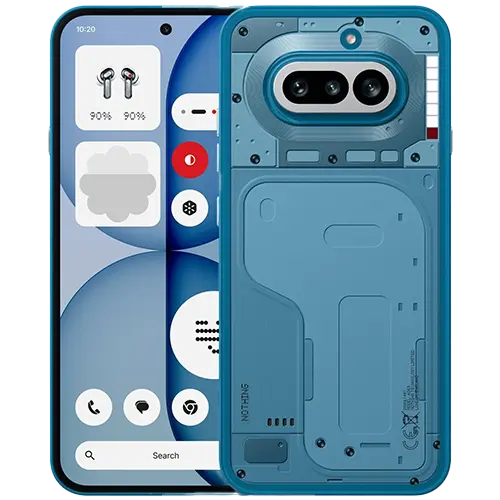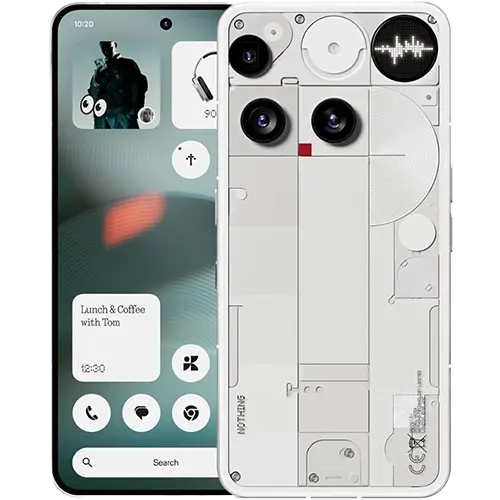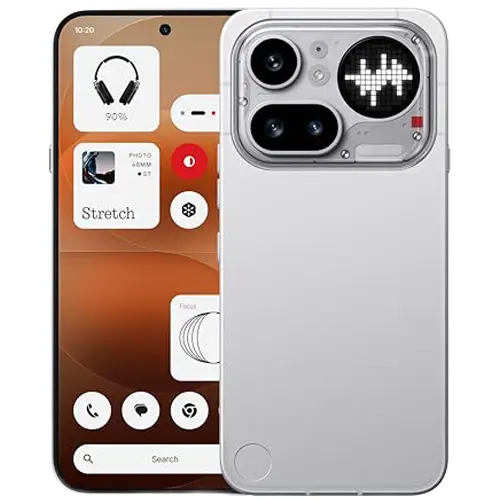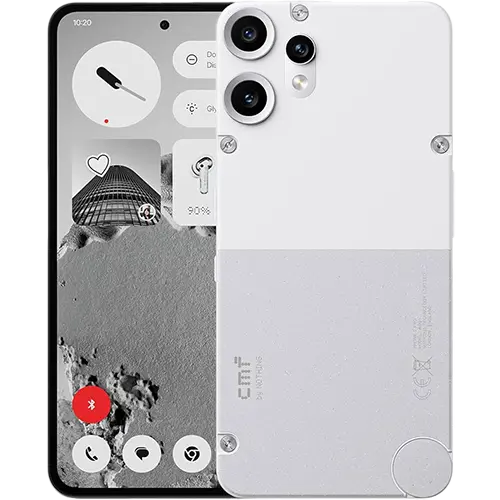
The Nothing CMF Phone 2 Pro is a $279 smartphone running a MediaTek Dimensity 7300 Pro processor with 8GB of RAM and a 5,000mAh battery. It sits under Nothing’s own Phone (4a) at $349 and the Phone (4a) Pro at $499. The camera system is unusually complete for this price — most phones in this price range don’t have a telephoto camera.
The trade-off for that camera hardware is a budget-tier processor that handles everyday tasks but struggles with demanding apps and gaming. Battery life is solid, the display is bright enough for outdoor use, and the phone is thin and light. No wireless charging and IP54 splash resistance rather than full waterproofing are expected at this price.
Design
Specifications
The Nothing CMF Phone 2 Pro measures 164 x 78 x 7.8mm and weighs 185 grams. It uses a plastic frame with Panda Glass on the front and a plastic back. The 6.77-inch display has a 19.9:9 aspect ratio and an 86.8% screen-to-body ratio. An IP54 rating protects against dust to a limited degree and against splashes from any direction, but the phone isn't rated for submersion. Bandicoot Lab does not formally test design or durability, so this section is descriptive rather than scored.
The CMF Phone 2 Pro's materials reflect its $279 price. Plastic frame and back are the most obvious cost-saving choices versus the aluminum-and-glass builds that dominate the flagship and mid-range markets. Panda Glass is a less well-known specification than Gorilla Glass and carries less track record for drop and scratch resistance. The IP54 rating is weaker than the IP68 found on the Moto G Power (2026) at $299.99, which also carries IP69 for high-pressure water jets, so buyers who need real water resistance at this price tier will want to weigh that tradeoff. At 7.8mm the CMF Phone 2 Pro is notably thinner than the Moto G Power at 8.7mm.
Display
The CMF Phone 2 Pro has a 6.77-inch AMOLED panel at 1080 x 2392 resolution (388 pixels per inch), refreshing at up to 120Hz with an adaptive range down to 30Hz.
Maximum manual brightness reaches 670 nits — a solid result that comfortably exceeds the Moto G Power’s 547 nits, though it falls below the Nothing Phone (4a) Pro’s 876 nits. HDR peak brightness is 1,266 nits with 100% stability across window sizes, meaning the display delivers the same peak brightness whether the HDR highlight is a small specular or a full-screen flash. The Moto G Power peaks at 1,021 nits. Sustained brightness holds at 98.6% over 30 minutes with no thermal throttling. Minimum brightness dips to 1.9 nits.
Color accuracy is where the display shows its price point. In Alive Mode (the best-performing mode), the average Delta E is 2.06 — which sounds reasonable, but the error distribution is uneven. Primary colors and saturated content are well-reproduced. The problem is in the upper grayscale: whites and near-whites consistently show a magenta-blue tint, and the error climbs as you move toward pure white. Standard Mode is worse at an average Delta E of 2.50 with the same white point issue. Alive Mode covers 96.9% of Display P3 and nearly 100% of sRGB. Standard Mode maps to sRGB at 98.6% coverage.
Touch latency averages 17.1 milliseconds — responsive and competitive with phones at double the price. The 120Hz refresh rate is smooth for scrolling and general navigation, though the 30Hz adaptive floor is higher than the 1Hz minimum found on more expensive LTPO panels, which means the display cannot drop as low for static content and will use slightly more power showing a still image.
Display Gamut Coverage
Sustained Brightness
HDR Brightness
HDR Tone Mapping
Performance
The CMF Phone 2 Pro has a MediaTek Dimensity 7300 Pro with 8GB of RAM. GeekBench 6 returns 1,012 single-core and 2,953 multi-core. Speedometer scores 9.47. The 3DMark Wild Life Extreme stress test peaks at 854 with 99.5% stability — the GPU doesn’t work hard enough to generate enough heat to throttle.
These are budget-tier results, though they sit well above the Moto G Power’s Dimensity 6300, which scores 792 single-core and 2,130 multi-core with a Speedometer of 6.11. The Nothing Phone (4a), at $70 more, scores 1,250 single-core and 3,374 multi-core in GeekBench 6 with a Speedometer score of 11.3 — a noticeable step up.
For messaging, social media, web browsing, and camera use, the Dimensity 7300 Pro handles the basics without issue. Demanding apps, heavy multitasking, and gaming are where the chipset’s limitations become apparent.
Performance Benchmarks
Bars positioned relative to the best score in our database.
Wild Life Extreme Stress Test
Camera
The CMF Phone 2 Pro has a four-camera system: a 50-megapixel f/1.9 main camera at 24mm with a 1/1.57-inch sensor, a 50-megapixel f/1.9 2x telephoto at 50mm with a 1/2.88-inch sensor, an 8-megapixel f/2.2 ultrawide at 15mm with a 1/4.0-inch sensor, and a 16-megapixel f/2.0 front camera. Digital zoom extends to 20x.
The standout is the dedicated 2x telephoto — this is hardware that costs multiples more on nearly every other phone. Having optical 2x means the phone doesn’t need to crop the main sensor for portrait-distance shots, and the telephoto delivers the strongest color accuracy of any lens on this device. Main camera sharpness is good for the price, with controlled sharpening in bright and mid conditions. The processing pipeline does a solid job resolving detail through the digital zoom range; sharpness at 3–5x holds up better than many phones that rely on main sensor crops at those focal lengths. The front camera is adequate.
Camera Sharpness
Main Camera
The main camera uses a 50-megapixel sensor with a 1/1.57-inch sensor size at f/1.9 and 24mm equivalent focal length.
Sharpness at 1x in bright light produces a clean result with controlled sharpening. Mid-light sharpness is similar, and low-light sharpness is actually quite. At 2x and beyond (using the dedicated telephoto), sharpness holds up well through the native optical range and degrades gradually through digital crop.
Color accuracy is moderate. The processing applies a mild saturation boost in bright conditions, producing slightly punchier colors than the scene contains, but it pulls back to near-neutral in darker conditions. Hue accuracy is moderate across lighting and degrades somewhat in low light. The degradation is driven primarily by the sensor struggling to distinguish hues as ISO rises — the white balance correction actually handles the warmer test lighting reasonably well across conditions. Skin tones show elevated error in bright auto mode, driven by the saturation boost rather than hue rotation.
Dynamic range is a genuine strength. The main camera captures a wide tonal range in auto mode with moderate tone curve compression and a clean transition from highlights to shadows. The auto dynamic range is strong for a phone at this price.
Video stabilization is weak though. Handheld walking video will show noticeable wobble and residual shake.
Color Profile
Dynamic Range
Ultrawide Camera
The ultrawide uses a small 8-megapixel sensor at f/2.2 with a 15mm equivalent focal length and a 1/4.0-inch sensor — the smallest sensor in the system.
Sharpness is reasonable for an 8-megapixel ultrawide. The low resolution means less detail overall, but the processing handles the output well in bright and mid conditions. Low-light sharpness drops as expected from the tiny sensor.
Color accuracy is the most vivid of any lens on this phone, with aggressive saturation boosting that produces punchy landscape and architectural shots. Hue accuracy is adequate in bright light, but in mid-light the camera shows signs of incomplete white balance correction — it doesn’t fully compensate for the warmer indoor-style lighting, which introduces a warm color cast. In dark conditions, hue accuracy degrades further as both white balance under-correction and sensor-level hue confusion contribute, though the white balance issue is more pronounced in mid-light specifically.
Dynamic range is strong for this sensor size, with the ultrawide capturing a wide tonal range in auto mode. Video stabilization is average.
Color Profile
Dynamic Range
Telephoto Camera
The telephoto uses a 50-megapixel sensor at f/1.9 with a 50mm equivalent focal length and a 1/2.88-inch sensor, providing a 2x optical zoom.
Sharpness at the native 2x focal length is good in bright and mid conditions, with restrained sharpening that produces clean edges without visible halos. Beyond 2x, digital crop quality degrades gradually through 3–5x and more aggressively at higher magnification.
Color accuracy is the telephoto’s standout quality and the best of any lens on this device by a meaningful margin. Hue accuracy is tight and stable across all three lighting conditions, which is unusual — most phone cameras show significant hue degradation in low light. The telephoto handles the warmer color temperatures used in mid-light and low-light testing well, with white balance correction that stays accurate where the main camera and ultrawide begin to struggle. Saturation is restrained, staying close to neutral across conditions. This combination of tight hue accuracy and restrained saturation makes the telephoto the most reliable lens for color-critical subjects like skin tones and product shots.
Dynamic range is the telephoto’s weakness though. It captures a narrower tonal range than the main camera in auto mode, with heavy tone curve compression. High-contrast scenes will lose shadow detail and compress highlights aggressively. The raw sensor captures a more linear but similarly limited range. Video stabilization is the weakest of any lens on the device.
Color Profile
Dynamic Range
Front Camera
The front camera is a 16-megapixel sensor at f/2.0 with a 22mm equivalent focal length and a 1/3.0-inch sensor.
Sharpness is adequate in bright and mid conditions, with moderate sharpening that increases noticeably in low light. Color accuracy is moderate with near-neutral saturation in bright and mid conditions. The processing actually desaturates images in low light, producing slightly muted output. Hue accuracy is good in bright conditions but degrades significantly in dark — both incomplete white balance correction for the warmer low-light test environment and sensor-level hue confusion contribute, with neither factor clearly dominating.
Dynamic range in auto mode appears wide on paper, but the processing achieves this by aggressively flattening the tone curve — essentially producing HDR-like images with significantly reduced contrast and frequent tonal inversions where darker steps render brighter than they should. The result is flat, low-contrast selfies in high-dynamic-range scenes. Raw mode captures a more limited but honest tonal range. Video stabilization is average.
Color Profile
Dynamic Range
Battery
The CMF Phone 2 Pro has a 5,000mAh battery. Video playback at 200 nits lasts 23 hours 35 minutes — a significant advantage over the Moto G Power’s 17 hours 34 minutes despite the G Power’s larger 5,200mAh cell. The Nothing Phone (4a) with its 5,080mAh battery reaches 23 hours 40 minutes — nearly identical. The Phone (4a) Pro stretches to 26 hours 19 minutes.
Web browsing drain over 5 hours is comparable to the Phone (4a) and the Moto G Power (2025). Gaming drain during the 3DMark Wild Life Extreme stress test is just 10%, though this reflects the low GPU power draw rather than power efficiency. Standby drain is 2% over 8 hours — a strong result.
The CMF Phone 2 Pro gets through a full day of mixed use comfortably. Battery life is solid for the price, though it doesn’t match the longer runtimes of phones like the Pixel 9a.
Battery Life
Charging
The CMF Phone 2 Pro supports 33W wired charging. There is no wireless charging.
Wired charging reaches 17% at 10 minutes and 50% at 30 minutes, with a full charge completing in about 76 minutes. The charging curve is unusual — rather than declining steadily as the battery fills, it dips in the 60–70% range and then steps back up before beginning its final taper. The Moto G Power reaches 58% in 30 minutes with its 30W charger — faster despite a similar wattage rating. The Nothing Phone (4a) Pro with its 50W charger reaches 63% in 30 minutes.
Wired Charging Curve
Speaker
The CMF Phone 2 Pro's speaker performed as expected for its price. Bass extension was limited with a 26.7 dB drop from the mids to the bass band, and the bass response was relatively uneven. The high end was its stronger area, with flat and extended treble. Loudness was a weak point at 68.2 dBA. Distortion of 5.9% was a positive, cleaner than the Phone (3a) Pro at 10.9% and well below the Moto G Power's 12.5%.
Speaker Frequency Response
Microphone
The microphone shows a standard deviation that’s well below average. The frequency response drops steeply above the upper midrange, meaning recordings lack the high-frequency presence and clarity that make voices sound natural. Voice calls will be intelligible, but the microphone is poorly suited for any situation where audio fidelity matters. This is a clear weak point.
Microphone Frequency Response
Other
Measurements
Specifications
The CMF Phone 2 Pro uses an optical fingerprint sensor with an average unlock speed of 229.2 milliseconds. This is below average — not slow enough to be frustrating, but there is a perceptible pause between contact and unlock.
USB data transfer is limited by the USB-C 2.0 port. Maximum read speed is 36.0MB/s and maximum write speed is 34.3MB/s. These are typical USB 2.0 transfer rates. The IP54 rating provides splash protection but not submersion resistance — a notable gap compared to the Moto G Power’s IP68/IP69 rating, which offers full dust and water protection at a similar price.
Conclusion
The Nothing CMF Phone 2 Pro’s most distinctive feature is its camera hardware — a dedicated 2x telephoto at $279 is a genuine differentiator that phones at double and triple the price often lack. The telephoto lens also happens to deliver the most color-accurate results of any lens on the phone. Main camera sharpness is good for the price, dynamic range is strong, and the speaker distortion is surprisingly clean.
The trade-offs are proportional to the price. The Dimensity 7300 Pro is a budget chipset with real limitations in GPU performance and multitasking. The display has a white-point issue that shifts whites toward magenta-blue, though primary colors are accurate. The microphone is weak, and the lack of wireless charging and limited water resistance are expected at $279. The Moto G Power at $300 takes the opposite approach. It prioritizes durability with IP68/IP69 and delivers a louder speaker, but its Dimensity 6300 chipset is slower, its display is dimmer, its battery life is substantially shorter, and it lacks a telephoto. Compared to the Nothing Phone (4a) at $70 more, the CMF Phone 2 Pro trades a faster processor and a brighter display for the telephoto lens and a lower price. Compared to the Phone (4a) Pro at $499, the gap widens across performance, camera processing, and display quality — but the CMF still offers a similar four-camera layout at just over half the cost. The CMF Phone 2 Pro’s value proposition is simple. It delivers a four-camera system with a real telephoto and clean audio at a price where most competitors offer two cameras and compromised speakers.