Apple
iPhone Air
Ranked #27 of 42 devices tested

Score Overview
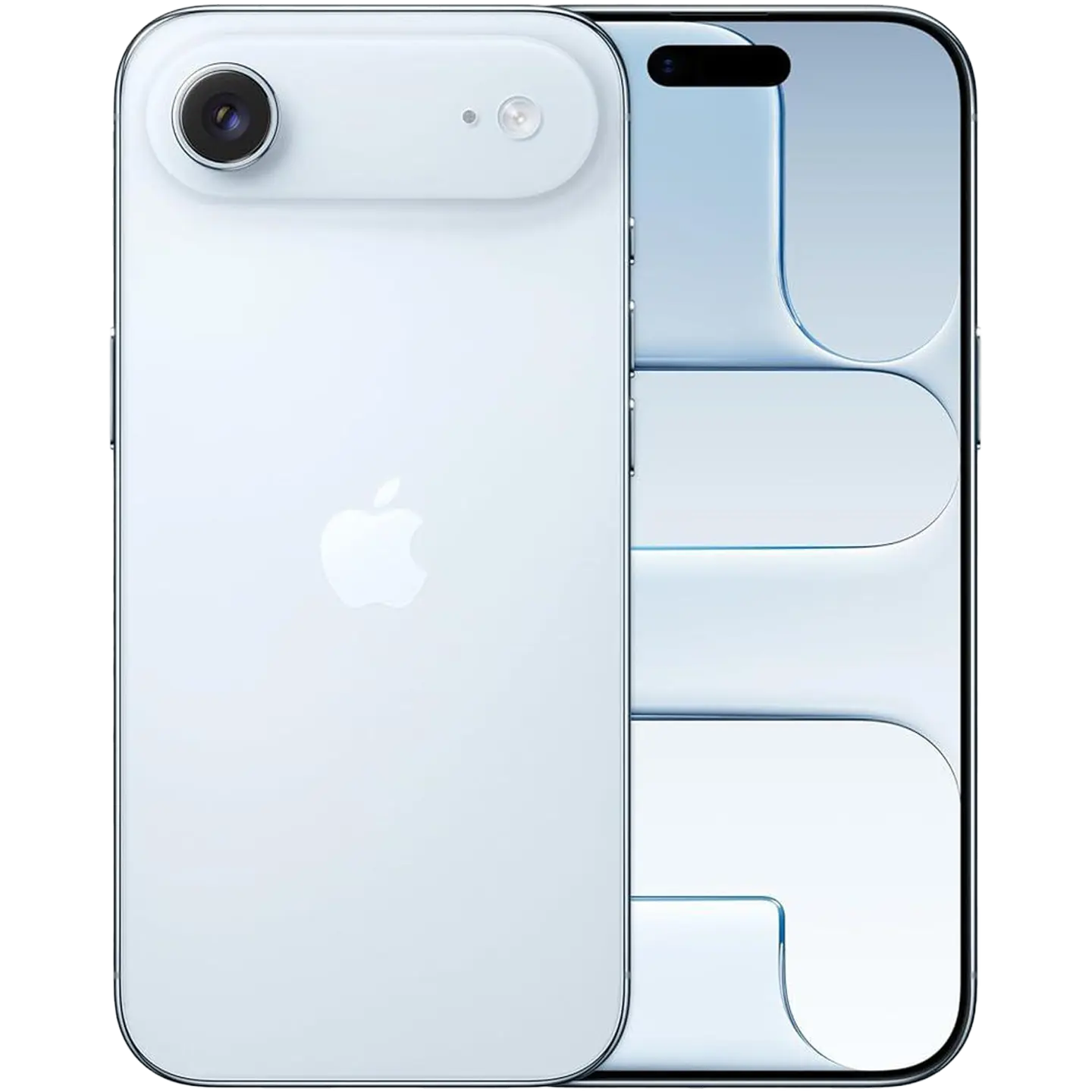
The iPhone Air is Apple's ultra-thin entry into the flagship smartphone space, slotting between the standard iPhone 17 and the iPhone 17 Pro at $999. At just 5.6mm thick and 165 grams, it's built around a 6.5-inch LTPO OLED display, an A19 Pro chip with 12GB of RAM, and a single rear camera — no ultrawide, and no dedicated telephoto. The design is clearly premium, but there a compromises to putting a thin build ahead of other things.
The iPhone Air's strengths include its fast processor, and the display is solid if not exceptional. The weaknesses include a weak battery life, which is among the shortest we've tested. Charging is slow. The single rear camera limits versatility significantly, and its overall camera performance trails nearly every competitor in and around its price.
Design
Specifications
The iPhone Air measures 156.2 x 74.7 x 5.6mm and weighs 165 grams. It uses a titanium frame with Ceramic Shield 2 on the front and a Ceramic Shield back. The 6.5-inch display has a 19.5:9 aspect ratio and an 88.9% screen-to-body ratio. An IP68 rating covers full dust ingress and fresh-water submersion beyond 1 meter, with depth and duration set by Apple. Bandicoot Lab does not formally test design or durability, so this section is descriptive rather than scored.
The iPhone Air's defining spec is thickness. At 5.6mm it's substantially thinner than any other current iPhone and lighter than all of them except the iPhone 17e. The titanium frame is a material Apple reserves for the Air in the iPhone 17 generation, with the Pro models dropping back to aluminum. That thinness comes at the cost of battery capacity (3149mAh, the smallest in the lineup) and internal space for additional cameras. Among same-price rivals, the Pixel 10 Pro at $999 is much chunkier at 8.5mm and 207 grams, and the Galaxy S25 Edge at $1,099.99 is closer in philosophy at 5.8mm thick and 163 grams, also titanium-framed.
Display
The iPhone Air has a 6.5-inch LTPO OLED display at 1260 x 2736 resolution (460 PPI), with a 1–120Hz adaptive refresh rate. Maximum manual brightness reaches about 851 nits, which is adequate for indoor use and passable outdoors but below the Pixel 10 Pro's roughly 1450 nits. HDR peak brightness hits 2,678 nits — competitive with the iPhone 17's 3,022 nits and the iPhone 17 Pro Max's 2,976 nits.
Color accuracy in its default mode is good, with a lowest average Delta E of 1.66 against sRGB. That means colors are close to their reference values — most people won't notice deviation in everyday use. The iPhone 17 Pro is noticeably better here with a Delta E of 0.85, while the iPhone 17 is comparable at 1.77. sRGB gamut coverage is 99.52%, essentially complete. Display P3 coverage sits at about 75%.
Touch latency averages 57.7ms, which is significantly higher than the Pixel 10 Pro's 11.6ms, the Samsung Galaxy S26+'s 15.9ms, or the OnePlus 15's 15.5ms. In practice, this latency probably won’t be perceptible.
Brightness stability is a weakness — the display holds only about 43% of its peak manual brightness over sustained use, which means the screen will dim noticeably during prolonged outdoor viewing. The iPhone 17 and 17 Pro show similar behavior (around 38–39%), but the OnePlus 15 and Samsung Galaxy S26+ maintain near-100% stability.
Display Gamut Coverage
Sustained Brightness
HDR Brightness
HDR Tone Mapping
Performance
The iPhone Air runs the Apple A19 Pro — broadly the same chip found in the iPhone 17 Pro and 17 Pro Max — paired with 12GB of RAM. Geekbench 6 returns a single-core score of 3,853 and multi-core of 9,681, essentially identical to the iPhone 17 Pro and well ahead of the Snapdragon 8 Elite-based Samsung Galaxy S25 Edge, which is Samsung’s take on the thin phone. The iPhone 17 with its non-Pro A19 chip is marginally behind.
GPU performance is solid. The Wild Life Extreme stress test peaks at 5,105, close to the iPhone 17 Pro's 5,865 and above the iPhone 17's 5,164. Thermal stability is a concern, though — the Air drops to 60.7% of its peak score over the stress test's 20 loops, with the device reaching 42.8°C. The iPhone 17 Pro maintains about 70% stability, and the iPhone 17 Pro Max reaches 73%. The thin chassis likely limits heat dissipation. For a burst of gaming or rendering, the Air performs well; sustained heavy workloads will see it throttle more than thicker phones.
Browser performance (Speedometer) comes in at 32.1, which is behind the iPhone 17 Pro's 43.1 and even the Samsung Galaxy S26+'s 44.3. This is a notable gap for a phone with the same SoC as the Pro models, and may reflect thermal or memory management differences. AI benchmark results are strong, with the Neural Engine scoring in line with the rest of the A19 Pro family.
Performance Benchmarks
Bars positioned relative to the best score in our database.
Wild Life Extreme Stress Test
Camera
The iPhone Air carries a single 48-megapixel main camera (f/1.6, 1/1.56" sensor, 26mm equivalent) and an 18-megapixel front camera (f/1.9). There's no ultrawide and no dedicated telephoto — all zoom is digital crop from the main sensor. At $999, this puts it at a significant hardware disadvantage against the Pixel 10 Pro (three rear cameras), the iPhone 17 Pro ($1099, three rear cameras), or even the $799 iPhone 17 (which adds an ultrawide). The overall camera score reflects this.
At 1x, the main camera produces sharp images in bright and low light. Sharpness drops steadily as you zoom in digitally. By 4x, detail is roughly halved compared to 1x. At 10x — the phone's maximum — results are soft, with the kind of detail loss you'd expect from a pure digital crop on a 1/1.56" sensor. The iPhone 17 Pro, with its dedicated 4x telephoto, produces dramatically sharper results at these zoom levels — roughly three times the resolved detail at 10x. The Pixel 10 Pro, with its 5x telephoto, shows a similar advantage. If you regularly photograph subjects at a distance, the Air's single-camera setup is a real limitation.
The front camera, by contrast, performs well. Sharpness is strong across lighting conditions, and it outperforms most competitors in our front-camera sharpness tests.
Camera Sharpness
Main
In bright light at 1x, the main camera resolves strong detail with moderate sharpening overshoot — the processing is aggressive enough to be visible on close inspection but not objectionable in normal viewing. In low light, resolved detail actually holds up well, though sharpening increases.
Color accuracy in processed photos follows Apple's typical approach — vivid and punchy. Saturation is boosted substantially, which makes photos look lively on screen but means colors don't necessarily match what you saw in person. Hue accuracy is reasonable in bright conditions, but degrades in mid-light and low light. In our mid-light tests (100 lux, 4000K — simulating warm indoor lighting), skin tones shift noticeably warm, with a strong yellow-orange bias from incomplete white balance correction for the warmer test illuminant. By low light (10 lux, 3000K), hue errors increase further, with the sensor struggling to separate colors accurately at higher ISO and the warm illuminant compounding the issue. The iPhone 17 shows very similar behavior with the same sensor.
Dynamic range in auto mode is good. The processing does clip highlights earlier than some competitors — the Pixel 10 Pro and Samsung Galaxy S26 handle bright-to-dark transitions with a bit more latitude — but the overall result is competitive for the sensor class.
Color Profile
Dynamic Range
Front
The 18-megapixel front camera (f/1.9, 20mm equivalent) is shared across the iPhone 17 lineup and performs well. Sharpness is strong in bright light and holds up in mid-light conditions, with only moderate falloff in dim environments.
Color processing on the front camera is heavily saturated in bright light — skin tones are pushed well above their true values. In mid-light and low light, hue errors increase due to both the sensor's higher-ISO limitations and the warmer test illuminants, similar to the rear camera's behavior. Dynamic range from the front camera is limited in auto mode, with highlight clipping visible in high-contrast scenes — the processing tends to overexpose highlights and compress the tonal range more aggressively than the rear camera. The iPhone 17 Pro handles front-camera dynamic range substantially better.
Video stabilization from the front camera is decent, performing better than the iPhone 17's front-facing stabilization but behind the iPhone 17 Pro's, which shoots at higher resolution and frame rate.
Color Profile
Dynamic Range
Battery
The 3,149mAh battery is small — smaller than any competitor in this comparison by a wide margin. The iPhone 17 has 3692 mAh, the Pixel 10 Pro has 4870 mAh, and the OnePlus 15 has 7300 mAh. The results reflect this.
Video playback at 200 nits lasts 17 hours and 13 minutes. That's serviceable for a day of moderate use, but it's about 5 hours shorter than the iPhone 17's 22 hours and 10 minutes, and nowhere near the OnePlus 15's 46 hours. At maximum brightness, playback drops to just under 15 hours. Web browsing drains 25% over 5 hours — meaning you'd empty the battery in about 20 hours of continuous browsing. The iPhone 17 loses 22% over the same period, and the OnePlus 15 just 16%.
Gaming drain is 27% during the stress test, identical to the iPhone 17 and Samsung Galaxy S25 Edge, and slightly worse than the iPhone 17 Pro's 24%. Standby drain is 3% over 8 hours overnight, which is solid.
In practical terms, the iPhone Air will get most people through a single day of moderate use. Heavy users will likely need a charge before the end of the day though. The battery is the most significant daily-use compromise of the thin design.
Battery Life
Charging
Wired charging is limited to 20W, the slowest in Apple's current lineup and well below most competitors. After 10 minutes on the cable, you'll have about 25% charge, and after 30 minutes, you’ll hit 58%. The iPhone 17, with 40W charging, reaches 73% in the same half hour. The OnePlus 15 hits 88% at 30 minutes with its 120W charger.
Wireless charging is also 20W, with MagSafe magnetic alignment. Wireless results are 23% at 10 minutes and 49% at 30 minutes — actually very close to the iPhone 17 Pro's wireless performance. This is partly because the smaller battery fills faster in percentage terms.
Wired Charging Curve
Wireless Charging Curve
Speaker
The iPhone Air's speakers reach a maximum of 72.9 dBA, which is loud enough for personal listening in quiet environments but slightly quieter than the iPhone 17's 75 dBA and the Pixel 10 Pro's 75.6 dBA. Average total harmonic distortion is 8.33%, which is moderate — you'll hear some harshness at high volumes, particularly in the upper frequencies, compared to the very clean output from the Samsung Galaxy S26+ (3.44% THD) or the iPhone 17 Pro (4.70% THD).
The overall character is somewhat thin. Bass response is restrained — there's minimal low-end weight to music or movie audio. High-frequency clarity is moderate, delivering intelligible vocals and decent separation, but the sound lacks the fuller, more balanced profile of the iPhone 17 or OnePlus 15, both of which produce more bass presence alongside their treble. The Samsung Galaxy S26+ also offers a more balanced sound signature with stronger bass and cleaner output overall. For a $999 phone, the speaker is functional but unremarkable.
Speaker Frequency Response
Microphone
The iPhone Air's microphone is a standout. Its frequency response is flat and even, with low standard deviation across the measured range. Voice recordings and calls sound natural, with minimal coloration.
Microphone Frequency Response
Other
Measurements
Specifications
Face unlock averages 527.7ms, which is slow. The iPhone 17 Pro Max is slightly faster at 487.5ms, but all of Apple's Face ID implementations in this generation are slower than the fingerprint-equipped alternatives — the OnePlus 15 unlocks in about 204ms, and the Samsung Galaxy S26 in about 226ms.
Data transfer is limited to USB-C 2.0, with maximum read speeds of 38.75 MB/s and write speeds of 38.03 MB/s. This is identical to the iPhone 17 and far behind the iPhone 17 Pro's USB 3.2 Gen 2 speeds (285 MB/s read) or the Samsung Galaxy S26+'s USB-C 3.2 (249 MB/s read).
Conclusion
The iPhone Air is a phone that prioritizes form factor above nearly everything else, and the test results make the trade-offs plain. It's genuinely thin and light, and it packs a capable A19 Pro processor and an excellent microphone into that slim frame. The display is competent, and the main camera produces good results at standard focal lengths.
But the compromises are significant. Battery life is short for a $999 phone. Charging is slow. The single rear camera means no ultrawide and no optical zoom, putting it well behind the Pixel 10 Pro at the same price and the $799 iPhone 17 in versatility. At this price, the iPhone 17 offers better battery life, an additional camera, and faster charging for $200 less. The iPhone 17 Pro, at $100 more, outperforms it in virtually every measured category. The iPhone Air is for buyers who value thinness as a primary feature and are willing to accept meaningful trade-offs elsewhere to get it.
Related
Apple
iPhone 17 Pro
Apple
iPhone 17 Pro Max
Apple
iPhone 17e
Apple
iPhone 17
OnePlus
15
OnePlus
13
Xiaomi
17
Samsung
Galaxy S26
Samsung
Galaxy S25+