Samsung
Galaxy S26+
Ranked #7 of 42 devices tested
Score Overview
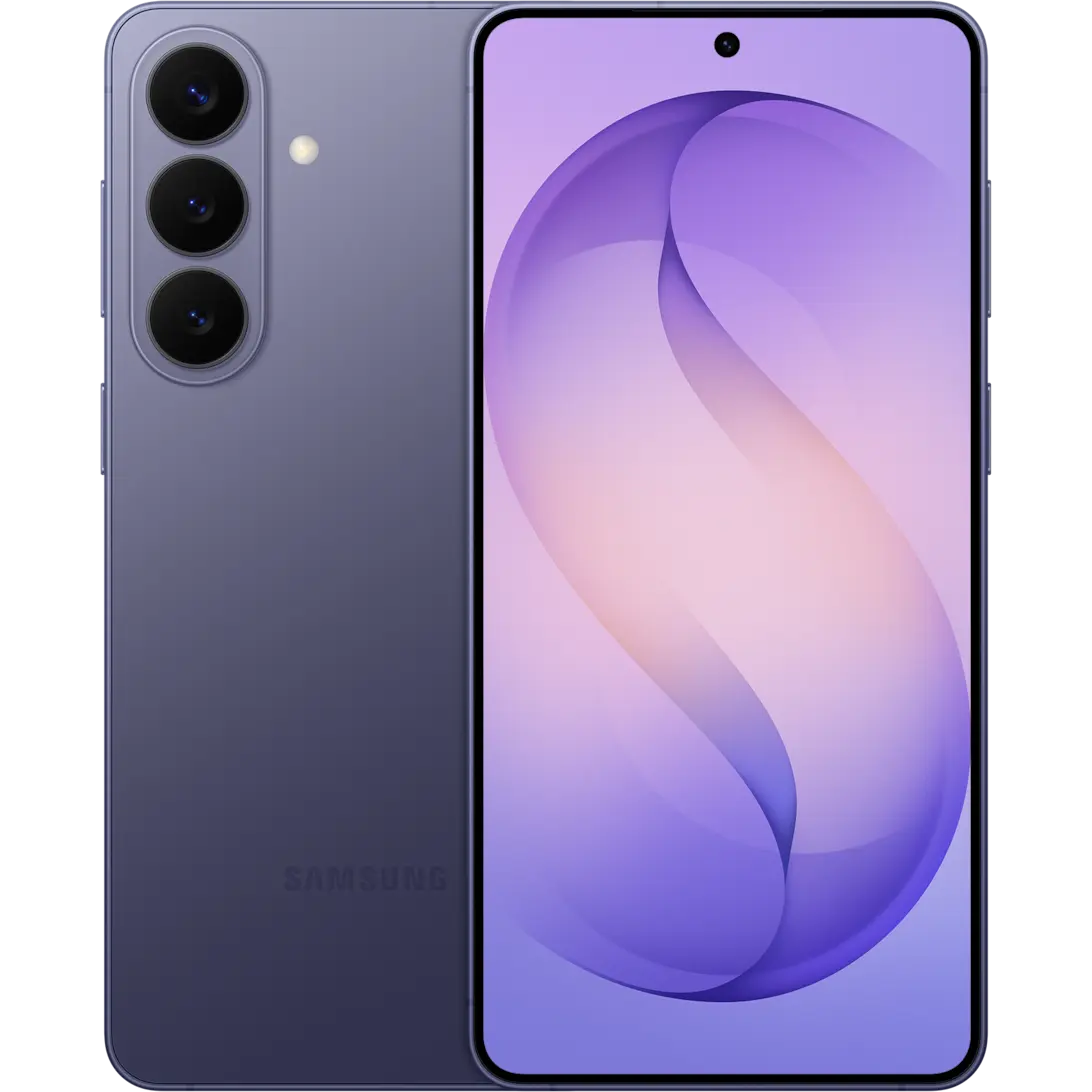
The Samsung Galaxy S26+ is a $1,099.99 phone that carries forward Samsung's familiar Plus-tier formula — a 6.7-inch LTPO AMOLED display at 1440 x 3120 resolution, a Snapdragon 8 Elite Gen 5 chipset, and a triple rear camera system. It shares the same physical dimensions and 190-gram weight as its predecessor, the Galaxy S25+, which launched at $999.99. The camera hardware — sensors, focal lengths, apertures — is also unchanged from the S25+, with the same 1/1.56-inch main sensor and compact telephoto module. The S26+ bumps wireless charging from 15W to 20W but otherwise keeps the same 45W wired charging and 4,900mAh battery capacity.
The S26+ performs very well in processing power and speaker quality, and its camera color accuracy is solid compared to most competitors at this price. Battery life is quite good too. The display is sharp and smooth but has middling color accuracy for its class and manual brightness that falls well behind several rivals. Here’s how it performed in our tests.
Design
Specifications
The Galaxy S26+ measures 158.4 x 75.8 x 7.3mm and weighs 190 grams. It uses an aluminum frame with Gorilla Glass Victus 2 on both the front and the back. The 6.7-inch display has a 19.5:9 aspect ratio and a 91.8% screen-to-body ratio. An IP68 rating covers full dust ingress and fresh-water submersion beyond 1 meter, with depth and duration set by Samsung. Bandicoot Lab does not formally test design or durability, so this section is descriptive rather than scored.
The S26+ has essentially identical physical dimensions to the Galaxy S25+ (158.4 x 75.8 x 7.3mm, 190 grams). The generation-to-generation changes are internal rather than external. Against same-price rivals the iPhone 17 Pro at $1,099 is smaller and heavier at 150 x 71.9 x 8.8mm and 206 grams, with a smaller 6.3-inch display. The Pixel 10 Pro XL at $1,199 sits in a larger size class at 162.8 x 76.6 x 8.5mm and 232 grams. Within Samsung's lineup the S26+ is the middle size, between the Galaxy S26 (167 grams, 6.3-inch display) and the Galaxy S26 Ultra (214 grams, 6.9-inch display).
Display
The Galaxy S26+ uses a 6.7-inch Dynamic LTPO AMOLED 2X panel at 1440 x 3120, yielding 516 pixels-per-inch. Refresh rate ranges from 1Hz to 120Hz. The display offers two color modes: Vivid, which targets the Display P3 gamut and covers 83.71% of it, and Natural, which targets sRGB with 97.71% coverage.
Manual brightness tops out at 635 nits, which is low for a phone at this price. The Pixel 10 Pro reaches nearly 1,450 nits manually, and the Galaxy S26 Ultra manages 976 nits. For outdoor readability under direct sunlight, the S26+ will struggle more than most alternatives. Minimum brightness drops to 0.59 nits — comfortable for use in very dark rooms. HDR peak brightness hits 2,725 nits, which is competitive, and brightness stability at 98.38% means the panel holds its brightness level reliably over time.
Color accuracy is a weak point. The best-performing mode is Natural, with an average Delta E of 3.87 — meaning colors deviate noticeably from their sRGB reference values across the spectrum. The iPhone 17 Pro achieves a Delta E of 0.85, and the Honor Magic8 Pro hits 0.82 in Normal mode. The S26+ display shifts some colors enough that photo editors or anyone color-sensitive will notice discrepancies. The Vivid mode is slightly worse at 3.98
Touch latency averages 15.9ms, which is a good result. It's faster than the Galaxy S25+'s 22.5ms and close to the Pixel 10 Pro's 11.6ms. In daily use, differences this small are unlikely to be perceptible.
Display Gamut Coverage
Sustained Brightness
HDR Brightness
HDR Tone Mapping
Performance
The Snapdragon 8 Elite Gen 5 powering the S26+ is paired with 12GB of RAM. Geekbench 6 scores land at 3,791 single-core and 11,523 multi-core, a substantial jump from the Galaxy S25+ on the prior-generation Snapdragon 8 Elite. The S26+ is closely matched with other Snapdragon 8 Elite Gen 5 devices. The iPhone 17 Pro posts a higher single-core result at 3,918 but trails in multi-core at 10,158.
GPU performance is strong. The S26+ reaches a peak score of 7,867 in 3DMark Wild Life Extreme, with stability settling at 59.5% as the device throttles under sustained load — the chip drops to 4,682 by the worst loop. In the Solar Bay test, peak performance hits a score of 14,132 with 52.3% stability. These figures are competitive with the Honor Magic8 Pro and slightly ahead of the OnePlus 15, though the Snapdragon 8 Elite Gen 5 devices don't sustain performance as consistently as the iPhone 17 Pro, which trades lower peak GPU output for better thermal stability.
Browser performance is solid, with a Speedometer score of 44.3 — closely matching the Honor Magic8 Pro and Galaxy S26 Ultra. The Galaxy S25+ scored 30.6, so this is a meaningful generation-over-generation improvement in web responsiveness.
Performance Benchmarks
Bars positioned relative to the best score in our database.
Wild Life Extreme Stress Test
Camera
The Galaxy S26+ has a 50-megapixel f/1.8 main camera with a 1/1.56-inch sensor, a 12-megapixel f/2.2 ultrawide, a 10-megapixel f/2.4 3x telephoto, and a 12-megapixel f/2.2 front camera. This is the same hardware used in the Galaxy S25+, with no changes to sensors, lenses, or apertures.
Overall camera performance is above average but not leading. The system's main strength is color accuracy — the S26+ produces some of the more accurate colors in its price range, with restrained processing that avoids the aggressive hue shifts seen in several competitors. Sharpness is more uneven. The ultrawide lens resolves detail very well, but the main camera, telephoto, and front camera all fall short of what the iPhone 17 Pro, Pixel 10 Pro, and OnePlus 15 deliver. Video stabilization is consistently weak across all lenses, too. Dynamic range is a strength, with the processing doing good work to extend usable range without introducing major tonal artifacts.
Camera Sharpness
Main
The 50-megapixel main sensor resolves detail reasonably well in bright light but doesn't keep pace with the best in this class. The iPhone 17 Pro and Pixel 10 Pro both extract more resolved detail from their larger main sensors at 1x. In mid and low light, the S26+ main camera maintains decent sharpness, though there's a visible step down from bright-light output. Processing applies moderate sharpening in auto mode.
Color accuracy from the main camera is strong. In bright light, Samsung's processing boosts saturation to deliver a more punchy look, but keeps hue accuracy tight, with color hue errors staying low. Skin tones shift from their reference values more than colors overall, but less so than on the iPhone 17 Pro or Pixel 10 Pro in the same condition. In mid-light conditions, saturation is nearly neutral and overall color error drops considerably. In low light, the camera becomes restrained with saturation, and color errors are low. The camera's white balance handles the warmer test lighting reasonably well. The increasing hue error in darker conditions is primarily a sensor-level limitation rather than a white balance failure.
Dynamic range in auto mode spans a decently high usable range, with minimal compression artifacts. The processing clips highlights, but the overall tonal rendering is smooth. This is a stronger result than the iPhone 17 Pro's main camera and comparable to the OnePlus 15.
Color Profile
Dynamic Range
Ultrawide
The 12-megapixel f/2.2 ultrawide uses a 1/2.55-inch sensor at 13mm equivalent. Despite the lower resolution, it achieved a good sharpness score. Sharpening overshoot is noticeable in bright and mid light but doesn't create objectionable haloing.
Color processing is vivid, but hue accuracy remains good in bright light. In mid-light conditions, hue errors increase more substantially, though. In low light, colors pull back toward neutral saturation and overall accuracy improves, though hue errors are moderate.
Dynamic range is good. The processing clips highlights, and compared to the main camera, the ultrawide captures slightly less total range but renders tones more linearly.
Color Profile
Dynamic Range
Telephoto
The 10-megapixel f/2.4 telephoto provides a 3x optical zoom at 67mm equivalent, using a compact 1/3.94-inch sensor. Sharpness is acceptable at the native 3x in bright light but drops off meaningfully beyond that — by 10x, resolved detail is moderate, and at the 30x maximum zoom, output is soft. The iPhone 17 Pro's 4x telephoto, with its larger sensor and higher resolution, produces sharper results at comparable and extended zoom levels.
Color is where this telephoto excels. It delivers the strongest color accuracy of any lens in the S26+ system across all lighting conditions. In bright light, saturation is gently boosted with good hue fidelity. In mid and low light, hue errors increase but remain moderate. Skin tone accuracy is solid in bright and mid light.
Dynamic range is particularly strong for a telephoto, and it actually gets a better dynamic range result than the main camera achieves, meaning the telephoto handles high-contrast scenes well.
Color Profile
Dynamic Range
Front
The 12-megapixel f/2.2 front camera uses a 1/3.2-inch sensor at 23mm equivalent. Sharpness is below average — it trails the iPhone 17 Pro's front camera and also falls short of the Pixel 10 Pro, and Honor Magic8 Pro front cameras. Detail drops further in mid and low light, which will be noticeable in indoor selfies.
Color accuracy is reasonable. In bright light, saturation is close to neutral, with moderate overall color error. In mid-light conditions, hue errors climb noticeably. In low light, skin tones are more accurate than overall color would suggest, with hue errors increasing further.
Dynamic range is limited. The auto processing compresses the tonal range substantially. High-contrast selfie scenarios will often blow out bright areas.
Color Profile
Dynamic Range
Battery
The Galaxy S26+ has a 4,900mAh battery, which is the same capacity as the Galaxy S25+. In our standardized video playback test at 200 nits, the S26+ lasted 31 hours and 8 minutes. At maximum brightness, that drops to 26 hours and 54 minutes. The S25+ managed 29 hours and 40 minutes at 200 nits, so the newer chip provides a modest efficiency gain. The OnePlus 15 with its much larger 7,300mAh battery reaches 46 hours, and the Honor Magic8 Pro hits 35 hours and 30 minutes. The iPhone 17 Pro, with a smaller 4,252mAh cell, reaches about 24 hours.
Web browsing drains 26% over five hours, which is middling — identical to the Xiaomi 17 and worse than the iPhone 17 Pro or the OnePlus 15. Gaming drain is 30% during the stress test, which is higher than most Snapdragon 8 Elite Gen 5 devices — the Honor Magic8 Pro and Pixel 10 Pro both drain 25%, and the OnePlus 15 only 23%. The S26+'s smaller battery is a factor here. Standby drain is excellent at just 2% over eight hours, matching the Galaxy S25+ and iPhone 17 Pro.
The S26+ will comfortably get through a full day of mixed use and into a second day for lighter users. Heavy gaming sessions will eat through the battery faster than most similarly priced phones, and the web browsing efficiency is average.
Battery Life
Charging
Wired charging uses a 45W adapter. After 10 minutes, the S26+ reaches 26% — down slightly from the Galaxy S25+'s 30%, which is unusual for a newer device with the same battery size. After 30 minutes, it hits 67%, compared to 74% on the S25+. The iPhone 17 Pro with its 40W charging gets to 31% in 10 minutes and 72% in 30 — faster on both counts. The OnePlus 15 (120W) reaches 37% in 10 minutes and 88% in 30, making the S26+ particularly slow in comparison.
Wireless charging at 20W — upgraded from the S25+'s 15W — yields 7% after 10 minutes and 19% after 30 minutes. The iPhone 17 Pro with MagSafe at 25W reaches 24% in 10 minutes and 49% in 30 — dramatically faster. A full wireless charge will take well over two hours.
Wired Charging Curve
Wireless Charging Curve
Speaker
The Galaxy S26+'s speaker was well-rounded. Bass extension was moderate with an 18.6 dB drop from the mids to the bass band, noticeably better than the Galaxy S25+'s 26.4 dB. The high end was clear with moderately extended treble. Loudness of 71.7 dBA was lower than the Galaxy S25+'s 77.2 dBA, which is a step back. Distortion was a strong point at 3.9%, cleaner than the iPhone Air's 8.3% and Pixel 10 Pro's 6.5%.
Speaker Frequency Response
Microphone
The S26+ microphone achieved a good result indicating fairly even capture across the frequency range. It scores above average for microphone quality. The Galaxy S25+ had slightly better microphone performance overall. For calls and voice memos, the S26+ will sound clear and balanced.
Microphone Frequency Response
Other
Measurements
Specifications
The S26+ uses an optical fingerprint sensor with an average unlock speed of 394.4ms. This is unusually slow — the Galaxy S25+ with its ultrasonic sensor unlocks in 202.8ms, and the Galaxy S26 Ultra manages 137.5ms.
Data transfer over USB-C 3.2 is solid. Large file reads average 249MB/s and writes reach 273MB/s — competitive with other USB-C 3.2 devices in this group. Small file performance is also reasonable. The Galaxy S26 Ultra and Honor Magic8 Pro are slightly faster overall, but the S26+ won't bottleneck typical file transfers.
Conclusion
The Galaxy S26+ is a competent flagship that excels in processing power, speaker quality, and camera color accuracy but falls short in several areas where $1,099 phones typically perform better. The Snapdragon 8 Elite Gen 5 delivers a meaningful performance upgrade over the S25+, and the camera system produces some of the most color-accurate photos in its price range — an advantage for anyone who values natural-looking output. Battery life is adequate, the display is sharp and responsive, and the speakers produce clean sound with unusually deep bass.
Manual display brightness, charging speed, fingerprint unlock speed, and camera sharpness from the main and front lenses all lag behind the iPhone 17 Pro and other alternatives at or below this price. The camera hardware is unchanged from the S25+, and it shows — sharpness improvements are minor at best. The OnePlus 15 at $899.99 offers dramatically better battery life and charging speed, and the iPhone 17 Pro at $1,099 has a stronger camera system and faster display color accuracy. The S26+ doesn't have a clear weakness severe enough to be a dealbreaker, but it also doesn't have a standout strength that makes it the obvious choice against its direct competition.
Related
Best Samsung Phones
Best-Performing Phones

Samsung
Galaxy S26 Ultra
Samsung
Galaxy S26
Samsung
Galaxy S25 Edge

Samsung
Galaxy Z Flip 7
Samsung
Galaxy Z Fold 7
Apple
iPhone 17 Pro
Apple
iPhone 17 Pro Max