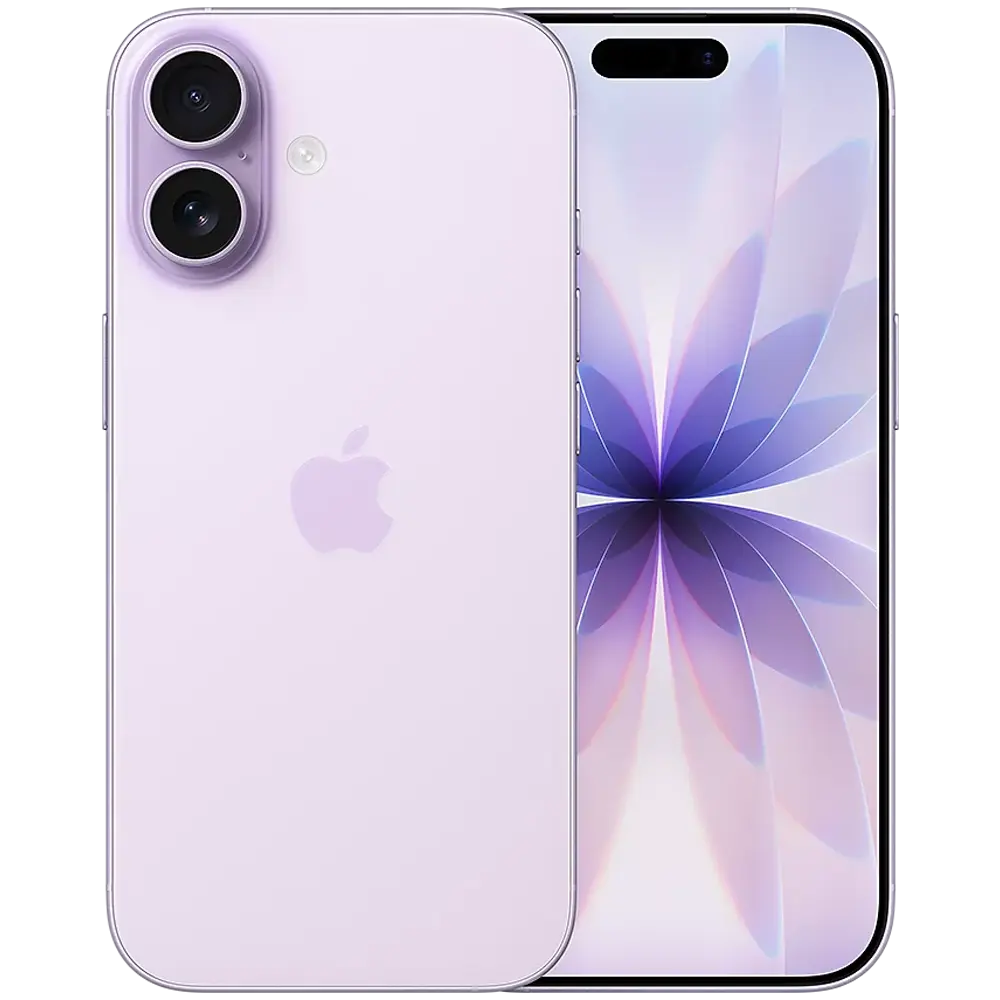
Apple
iPhone 17
Ranked #18 of 42 devices tested
Score Overview
The Apple iPhone 17 is the standard-tier model in Apple’s iPhone 17 lineup, positioned below the iPhone 17 Pro and iPhone Air. It targets buyers who want an iPhone without stretching into flagship pricing, and who don’t need a telephoto camera or the Pro’s higher-end internals.
The iPhone 17 performs well in speaker quality and raw processing power, and its battery life is reasonable for the size of its cell. Its camera system isn’t bad, but it does fall short relative to the competition — sharpness on the main lens lags behind phones at this price, and there's no telephoto lens. The display is competent, but with color accuracy and brightness that sit behind several peers.
Here’s how the iPhone 17 performed in our testing.
Design
Specifications
The iPhone 17 measures 149.6 x 71.5 x 8mm and weighs 177 grams. It uses an aluminum frame with Ceramic Shield 2 on the front and a glass back. The 6.3-inch display has a 19.5:9 aspect ratio and a 91.1% screen-to-body ratio, which translates to thin bezels around the panel.
The iPhone 17 is one of the lighter phones in its price class. The Samsung Galaxy S26 at $899.99 is 10 grams lighter at 167 grams but also thinner at 7.2mm, and the Google Pixel 10 at the same $799 price is heavier at 204 grams and slightly thicker at 8.6mm. Within Apple’s lineup the iPhone 17 sits between the iPhone Air (165 grams, 5.6mm thick, titanium frame) and the iPhone 17 Pro (206 grams, 8.8mm thick). Compared to the iPhone 16, the direct predecessor at 170 grams and 7.8mm, the iPhone 17 has grown slightly in all three dimensions.
Display
The iPhone 17 uses a 6.3-inch LTPO OLED panel at 1206 x 2622 resolution (460 PPI), with a refresh rate that scales between 1Hz and 120Hz. Manual brightness tops out at about 854 nits, and HDR peak brightness reaches 3022 nits, though brightness stability drops to around 39%, meaning the panel dims noticeably during sustained bright scenes. Minimum brightness goes down to 0.9 nits, which is good for nighttime use.
Color accuracy in Standard mode is solid, with an average Delta E of 1.77 against an sRGB target. That means colors are close to their reference values — most users won't notice meaningful deviation from real-life tones. The display covers nearly all of sRGB (99.8%) and about 75% of Display P3. The iPhone 17 Pro does meaningfully better here with an average Delta E of 0.85, which is essentially indistinguishable from reference, but the standard iPhone 17's accuracy is still reasonable.
Touch latency averages 57ms. That's noticeably higher than the 22.6ms on the Google Pixel 10 or the 15.5ms on the OnePlus 15, and even trails the iPhone 17 Pro's 52.7ms. In practice, most users won't perceive the difference during typical scrolling and tapping, though. The Samsung Galaxy S26, at 21.8ms, is nearly three times faster in this metric.
HDR tone mapping shows a clip point at 80% of the PQ curve with a peak of about 1549 nits in tone-mapped content. The Pixel 10 handles HDR mapping more precisely, but the iPhone 17's approach is typical for Apple's lineup, and certainly not bad.
Display Gamut Coverage
Sustained Brightness
HDR Brightness
HDR Tone Mapping
Performance
The iPhone 17 is powered by the Apple A19 chip with 8GB of RAM. In Geekbench 6, it posts a single-core score of 3772 and a multi-core score of 9645. Those are strong figures that outpace the Snapdragon 8 Elite Gen 5 in single-threaded work (the Samsung Galaxy S26 scores 3709 single-core) while trailing in multi-core, where the Galaxy S26 reaches 11,232. The iPhone 17 Pro, with its A19 Pro, edges ahead at 3918 single-core and 10,158 multi-core.
GPU performance is similar. In 3DMark Wild Life Extreme, the iPhone 17 peaks at 5164 and stabilizes at 3657, yielding 70.8% stability. The phone gets warm under load (45.6°C) and loses about 30% of its peak performance over the stress test duration. The OnePlus 15 peaks higher at 7160 but drops to 63.7% stability with similar thermal behavior. The iPhone 17 Pro maintains a comparable peak of 5865 with 69.8% stability at a lower temperature (41.4°C), so the Pro handles sustained GPU loads with slightly less throttling.
Browser performance via Speedometer comes in at 33.5, which is strong. The iPhone 17 Pro reaches 43.1, a gap that reflects the Pro's faster CPU and 12GB of RAM. The Galaxy S26 lands at 36.7, and the Pixel 10 trails significantly at 20.3.
AI benchmark scores are modest at 48,468 quantized, running on the Neural Engine. These are nearly identical to the iPhone 17e and iPhone Air, which share the same Neural Engine architecture.
Performance Benchmarks
Bars positioned relative to the best score in our database.
Wild Life Extreme Stress Test
Camera
The iPhone 17 has a dual-lens rear camera, made up of a 48-megapixel main (f/1.6, 1/1.56" sensor, 26mm) and a 48-megapixel ultrawide (f/2.2, 1/2.55" sensor, 13mm). There's no telephoto camera, and digital zoom maxes out at 10x. The front camera is 18-megapixels at f/1.9 with a 20mm focal length.
Camera performance is below the price-class average. Sharpness on the main lens is the primary weakness, scoring well below rivals like the iPhone 17 Pro, Galaxy S26, and OnePlus 15. The ultrawide is more competitive in sharpness, and color processing is consistent across lenses — Apple's pipeline applies a vivid, saturated look that's punchy but not wildly inaccurate in terms of hue. Dynamic range on the main and ultrawide lenses is a genuine strength.
Camera Sharpness
Main
At 1x in bright light, the main lens resolves detail adequately but trails the iPhone 17 Pro and OnePlus 15 by a significant margin in sharpness. The gap narrows somewhat in mid-light but remains. In low light, sharpness holds up better relative to its bright-light performance, but the absolute level of detail is still below what similarly-priced phones deliver. Sharpening is applied conservatively — overshoot stays low across conditions, so images look natural rather than artificially crispy.
Color processing is vivid. In bright light, saturation runs around 127% of reference values — skin tones in particular are pushed well above their true appearance, which makes portraits look warmer and more saturated than reality. Hue accuracy is reasonable in bright conditions, meaning colors are boosted but not rotated to incorrect values. In mid-light and low light, the white balance correction doesn't fully compensate for the warmer color temperatures used in those environments, introducing a warm yellow-orange shift that compounds with the saturation boost. Hue accuracy degrades in low light, where hue errors roughly double compared to bright conditions — this is a mix of sensor-level color confusion at higher ISO and incomplete white balance correction.
Dynamic range is one of the main lens's clear strengths. The processed output captures a wide tonal range with good highlight retention, and compression is high — the tone curve aggressively lifts shadows and manages highlights. This is Apple's computational HDR doing heavy work, and it's effective.
Color Profile
Dynamic Range
Ultrawide
The 48-megapixel ultrawide is sharper than the main lens in our testing — likely reflecting stronger software sharpening and the higher-resolution output at this focal length. In bright light, it resolves more detail than the main camera at 1x. In low light, sharpness drops, but it remains competitive with other ultrawide cameras in this price range.
Color behavior mirrors the main lens closely in bright light, with saturation boosted to about 122% of reference. Hue accuracy is slightly better than the main lens in bright conditions. In mid-light and low light, the same warm shift appears as white balance correction falls short, and hue errors increase. In dark conditions, saturation actually drops below reference and hues shift more — the processing seems to struggle more with the ultrawide's smaller sensor in low light.
Dynamic range is strong, slightly exceeding the main lens in usable range. The ultrawide captures a wide spread from shadows to highlights, and tonal transitions are smooth without any inversions or stepping.
Color Profile
Dynamic Range
Front
The 18-megapixel front camera at f/1.9 performs adequately for selfies. Sharpness is reasonable in bright and mid-light, and it doesn't fall off as dramatically in dark conditions as some front cameras do. Video stabilization on the front camera is moderate.
Color processing on the front camera follows the same general pattern as the rear lenses. There’s vivid saturation boost in bright light with skin tones pushed well above reference. In mid-light and low light, hue errors increase and a warm shift becomes evident. The front camera shows slightly better overall color scores than the main and ultrawide lenses, likely because its processing is tuned to handle a narrower range of skin-tone scenarios.
Dynamic range is limited compared to the rear cameras. The processed output covers a narrower tonal range, and there's visible highlight clipping. For standard selfie lighting this is adequate, but backlit or high-contrast scenes will lose detail in the highlights.
Color Profile
Dynamic Range
Battery
The iPhone 17 houses a 3692mAh battery — small by the standards of its Android competition. The OnePlus 15 packs 7300mAh, the Pixel 10 has 4970mAh, and even the cheaper iPhone 17e has 4005mAh. The real question is whether Apple's efficiency compensates for the smaller cell.
Video playback at 200 nits reaches 22 hours and 10 minutes. That's a full day of continuous video, and in practice translates to comfortably lasting a full day of mixed use for most people. At maximum brightness, playback drops to about 19 hours and 14 minutes. For comparison, the iPhone 17 Pro stretches to nearly 24 hours at 200 nits thanks to its larger 4252mAh battery, and the OnePlus 15 reaches 46 hours with its enormous cell.
Web browsing drain is 22% over five hours, which is middle of the pack. The iPhone 17 Pro loses only 17% in the same test, and the OnePlus 15 just 16%. The Galaxy S26 drains 24%, putting the iPhone 17 in roughly the same neighborhood.
Gaming drain is 27% during the stress test — identical to the iPhone Air and Galaxy S26. The iPhone 17 Pro is more efficient here at 24%, and the OnePlus 15 comes in at 23% despite its much higher GPU output, though its 7300mAh cell makes percentage comparisons misleading.
Standby drain is excellent at 2% over 8 hours overnight, matching the iPhone 17 Pro and Galaxy S26.
Battery Life
Charging
The iPhone 17 supports 40W wired charging and 25W wireless charging with MagSafe magnetic alignment. Wired charging reaches 28% in 10 minutes and 73% in 30 minutes. That's respectable but not fast — the OnePlus 15 with its 120W charger hits 37% in 10 minutes and 88% in 30, despite charging a battery that's nearly twice the size.
Wireless charging reaches 25% in 10 minutes and 49% in 30 minutes, which is competitive for wireless speeds and nearly matches the iPhone 17 Pro's wireless performance.
Within Apple's own lineup, the iPhone 17 Pro charges at a similar pace (31% wired in 10 minutes, 72% in 30), while the iPhone 17 Pro Max edges ahead in wireless charging with its larger battery reaching 47% in 30 minutes. The iPhone 17e, with only 20W wired charging, is meaningfully slower at 25% in 10 minutes and 61% in 30.
Compared to Android alternatives, the charging speeds are behind the curve. The Galaxy S26 is slower on paper at 25W wired, but phones like the OnePlus 15 at 120W make the iPhone 17's charging feel conservative.
Wired Charging Curve
Wireless Charging Curve
Speaker
The iPhone 17's speakers reach a maximum volume of 75 dB, which is loud enough for most settings and comparable to the iPhone 17 Pro's 75.2 dB. Average total harmonic distortion is 9.69% — elevated compared to the iPhone 17 Pro's 4.7% and the Galaxy S26's low 3.4%. At higher volumes, this distortion becomes audible as a slight harshness, particularly in vocals and upper midrange content.
The speaker's frequency response has a standard deviation of 5.85 dB, indicating moderate unevenness across the frequency range. The iPhone 17 still delivers more bass energy than the iPhone Air. Mids are strong, and high-frequency consistency is good with a standard deviation of just 1.75 dB in the treble range.
Speaker Frequency Response
Microphone
The microphone shows a standard deviation of 4.52 dB across its frequency range, which is slightly above average. It's adequate for calls and voice memos, with a response that's broadly comparable to the iPhone 17e's 4.51 dB standard deviation. The iPhone 17 Pro is slightly less consistent at 5.19 dB, while the iPhone Air performs better at 3.16 dB. For typical voice recording and call use, the iPhone 17's microphone is serviceable.
Microphone Frequency Response
Other
Measurements
Specifications
Face unlock via Face ID averages 508ms, which is slow compared to fingerprint-based systems. The Galaxy S26's ultrasonic fingerprint sensor unlocks in 226ms, and the OnePlus 15 manages 204ms. Face ID is simply a slower biometric method than modern fingerprint sensors — though some might find it more convenient.
Data transfer over USB-C 2.0 is limited. Large file read speeds reach about 38.8MB/s and write speeds about 37.8MB/s — functional for basic transfers but dramatically slower than USB 3.2 devices. The iPhone 17 Pro, with USB-C 3.2 Gen 2, reads at 285MB/s. The Galaxy S26 hits 335MB/s. For users who regularly transfer large files, the USB 2.0 port is a bottleneck.
Conclusion
The iPhone 17 is a competent phone that executes the basics well without excelling in any single area. Its A19 chip delivers strong single-core performance and smooth daily operation. Battery life is adequate for the small cell size. The speakers are loud and clear. The display is accurate enough for most users, even if it doesn't match the Pro models' calibration or the brightness and responsiveness of Android alternatives like the Pixel 10.
The camera is a compromise. Without a telephoto and with main lens sharpness that falls behind the Galaxy S26, Pixel 10, and the iPhone 17 Pro, the $799 price puts it in competition with phones that offer more versatile and sharper imaging systems. Slow biometrics and USB 2.0 data transfer are practical downsides, though they might be issues people can live with more. Buyers willing to spend $100 more on the Galaxy S26 or OnePlus 15 get meaningfully better cameras, faster biometrics, and faster wired data transfer — though they move to Android. Within Apple's lineup, the $300 jump to the iPhone 17 Pro buys a substantially better camera, longer battery life, faster data transfer, and improved display accuracy.
Related
Best iPhones
Apple
iPhone 17 Pro
Apple
iPhone 17 Pro Max
Apple
iPhone 17e
Apple
iPhone Air
OnePlus
13
OnePlus
15R
Samsung
Galaxy S25
Xiaomi
15T Pro
Nothing
Phone (3)